Power Purchase Agreement PPA Market to Reach USD 1,200 Billion by 2032 on Renewable Energy Demand
Power purchase agreements provide long-term contracts for electricity at agreed prices, giving renewable developers revenue certainty while offering buyers price stability and sustainability credentials. According to WiseGuyReports, the global power purchase agreement PPA market was valued at USD 459.54 billion in 2023 and is projected to reach USD 1,200 billion by 2032, growing at a compound annual growth rate of 11.25%. This article examines the technologies, buyer types, and regional dynamics behind that growth.
Renewable Demand and Policy Support Drive Growth
The market's expansion is anchored in strong demand for renewable energy and the need to transition to sustainable sources, with governments worldwide promoting PPAs as a way to reduce carbon emissions and meet renewable energy targets, and PPAs providing long-term revenue for renewable developers, encouraging investment and development of solar and wind projects. Insights published by WiseGuyReports indicate that PPAs reduce the financial risk associated with renewable projects by providing a guaranteed revenue stream, with contracts typically long-term at 10 to 20 years giving developers a stable revenue source throughout project life, while government support includes financial incentives such as tax breaks, grants, and subsidies that reduce project costs and make them more attractive to investors, alongside regulatory support including renewable portfolio standards requiring utilities to produce a certain percentage of electricity from renewable sources. Technological advances also drive growth, with renewable technologies becoming more efficient and cost-effective — for example, the cost of solar panels has fallen significantly in recent years making solar power more affordable for businesses and consumers, and new battery technologies allow storage of excess solar and wind energy for use when the sun is not shining or the wind is not blowing, making renewables a more viable option for baseload generation.
Solar Leads the Technology Segment
In the technology segment, solar PPAs are expected to reach USD 120 billion in 2024 at an estimated 12.5% CAGR, having gained popularity thanks to falling technology costs and growing demand for clean energy. Wind is another significant segment with a projected market value of USD 90 billion in 2024 at a 10.8% CAGR, with wind PPAs offering long-term price stability and helping reduce greenhouse gas emissions, while hydro is a mature technology with a USD 80 billion market in 2024 at a 5.6% CAGR providing reliable, cost-effective power especially in regions with abundant water resources, geothermal offers a stable, renewable source with a USD 25 billion market in 2024 at a 7.2% CAGR, and biomass PPAs with a USD 20 billion market in 2024 at a 6.5% CAGR contribute to waste reduction. Fossil fuels also play a role, with coal PPAs at USD 100 billion in 2024 at a 2.8% CAGR offering relatively low-cost power and natural gas PPAs at USD 75 billion in 2024 at a 4.5% CAGR offering flexibility and dispatchability. On the buyer type side, utilities are the dominant buyer type representing over 50% of market share due to growing electricity demand from residential, commercial, and industrial sectors, companies are another major buyer type motivated by the need for renewable energy to meet sustainability goals and reduce operating costs, municipalities play an important role with growing numbers of cities setting renewable targets, and financial institutions are emerging as a new buyer type investing in PPAs as a source of stable long-term returns. On the contract type side, fixed-price PPAs guaranteeing a fixed electricity price for the contract duration represented the largest revenue share in 2023, indexed PPAs linking price to an index such as inflation or fuel cost are expected to see significant growth thanks to their ability to mitigate price volatility, variable-rate PPAs suit buyers able to tolerate price risk, and hybrid PPAs combine elements to offer customized solutions. On the contract duration side, long-term contracts of over 10 years represented the largest share in 2023 and are expected to continue dominating thanks to offering the lowest electricity cost and greater stability for both buyers and sellers. On the project stage side, early-stage development held a significant share in 2023 thanks to the growing number of planned and developing renewable projects, advanced development and construction are expected to see substantial growth as projects move from planning to construction, and operational is expected to see steady growth supported by the long-term nature of PPAs.
North America Leads as Asia Pacific Accelerates
Regionally, North America is expected to dominate the market in 2023 with revenue of USD 225.3 billion thanks to strong energy infrastructure combined with growing demand for renewable sources, with Europe following closely at USD 135.4 billion in 2023 driven by strict environmental regulations and a concerted push toward decarbonization, and the Asia Pacific region expected to see significant growth with a projected market size of USD 105.7 billion in 2023 as growing economies and ambitious renewable targets fuel demand. South America and the Middle East & Africa represent emerging markets with vast potential for PPA adoption, offering growth opportunities for market participants.
Competition Centers on Portfolio Diversity and Geographic Reach
Leading players use various competitive strategies to gain advantage, including mergers and acquisitions, partnerships, and new product development to maintain market positions, with key strategies including expanding geographic presence, investing in research and development to improve product offerings, and forming strategic alliances with other industry players, and the market landscape is expected to consolidate further in coming years as the number of market participants decreases and the market share of leading players increases. Engie SA is a leading player, based in France with a presence in over 70 countries and about 170,000 employees, actively involved in developing, producing, and distributing electricity plus providing energy services, with a strong presence in renewables having invested heavily in solar and wind projects and expanded geographically in recent years including into emerging markets, committed long-term to sustainability and focused on reducing environmental impact. NextEra Energy is another key player, based in the US with a presence in 26 states and over 14,000 employees, the largest electric utility in the US and also highly present in renewables, leading in developing and operating solar and wind projects and actively participating in energy storage technology development, with a strong focus on innovation and commitment to investing in new technologies. Industry observations from WiseGuyReports note that recent developments include the rise of virtual PPAs allowing companies to buy renewable energy without owning or operating a physical asset, plus a growing trend toward long-term PPAs as companies seek stable, predictable energy prices.
Conclusion
With an 11.25% CAGR projected through 2032, the power urchase agreement PPA market reflects the financial architecture of the penergy transition. Findings from WiseGuyReports suggest that developers and buyers combining indexed and hybrid contract structures, storage-backed renewable portfolios, and broad geographic diversification will be best positioned to capture growth.
Catégories
Lire la suite
As pharmaceutical development grows increasingly complex and capital-intensive, contract development and manufacturing organizations (CDMOs) have become indispensable partners for companies seeking to bring new therapies to market efficiently. From small biotech startups to large multinational pharmaceutical companies, outsourcing manufacturing operations allows organizations to focus internal...

Advances in molecular biology are creating opportunities to study diseases at increasingly detailed levels. Researchers are moving beyond broad tissue-level measurements to investigate how individual cells contribute to biological processes and disease development. Single-cell RNA sequencing is supporting this shift by providing gene-expression information from individual cells, helping...
Strengthening the national mental health network within the Sistema Nacional de Salud (SNS) is driving modern care delivery across Spain. Detailed analysis within the Spain Behavioral Health Services Market report demonstrates how regional health authorities are integrating psychologists into primary health centers (Centros de Salud). Community-based mental healthcare models prioritize early...
Transforming reproductive health monitoring through rapid, highly sensitive over-the-counter diagnostic tools is driving steady expansion across the global pregnancy test kits market. Detailed analysis within the Pregnancy Test Kits Market report demonstrates how lateral flow immunoassay strips, digital result screens, and early-detection urine test devices deliver results with precision...
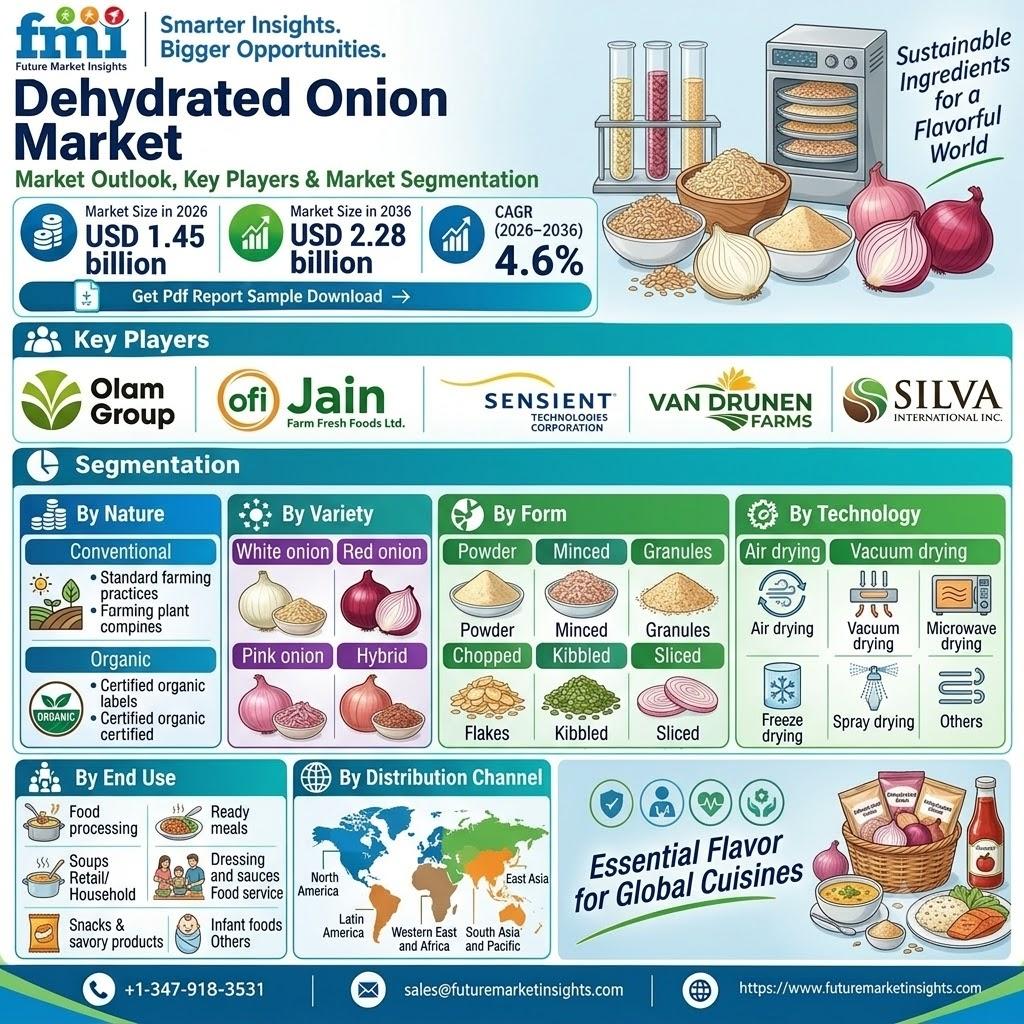
NEWARK, Del., October 9, 2026. — The global dehydrated onion market is estimated at USD 1.45 billion in 2026 and is projected to reach USD 2.28 billion by 2036, expanding at a CAGR of 4.6% from 2026 to 2036, according to Future Market Insights (FMI). The market stood at USD 1.385 billion in 2025. The growth outlook is being shaped by increasing production of processed and convenience...