


FDM 3D Printer Market to Reach USD 22.5 Billion by 2032 on Additive Manufacturing Adoption
Fused deposition modeling has become the most widely adopted 3D printing technology, turning digital designs into physical parts layer by layer from thermoplastic filament. According to WiseGuyReports, the global FDM 3D printer market was valued at USD 3.62 billion in 2023 and is projected to reach USD 22.5 billion by 2032, growing at a compound annual growth rate of 22.49%. This article examines the materials, applications, and regional dynamics behind that growth.
Technology Advances and Prototyping Demand Drive Growth
The market's expansion is anchored in continuous technological progress in new materials, software, and hardware, which has broadened FDM printer capabilities while making them more accessible to a wider range of users. Insights published by WiseGuyReports indicate that the introduction of high-performance thermoplastics has enabled production of stronger, more durable parts, while user-friendly software has simplified design and printing. Growing demand for prototyping and product development is another key factor, as FDM printers offer a cost-effective and fast way to create prototypes, allowing companies to test and iterate designs rapidly — driving strong adoption in automotive, aerospace, and consumer electronics. Growing adoption in education and research is also contributing, as institutions from primary schools to universities increasingly integrate FDM printers into curricula.
Desktop Printers Lead as Benchtop Grows Fastest
In the printer size segment, desktop printers are expected to hold the largest market share in 2024, accounting for over 50% of global revenue, driven by the growing popularity of 3D printing in homes and small businesses thanks to affordability and ease of use. The benchtop segment is expected to grow at the fastest CAGR through the forecast period, driven by increasing adoption across manufacturing, healthcare, and education, as these printers offer larger build volumes and greater precision than desktop units. The industrial segment is expected to hold a significant share, driven by growing demand for 3D-printed parts in automotive, aerospace, and defense. On the application side, prototyping is expected to hold the largest market share in 2023, while manufacturing is expected to grow significantly through increasing adoption for producing complex and customized parts, and the medical segment is expected to see substantial growth through production of medical devices and implants.
Standard Print Quality Leads the Segment
Within the print quality segment, standard held the largest revenue share in 2024, driven by widespread adoption in prototyping, hobbyist projects, and low-volume production. The high-precision sub-segment is expected to see significant growth through the forecast period, driven by growing demand from the automotive, aerospace, and medical industries, while the ultra-high-precision sub-segment, though currently specialized, is gaining ground in research and development applications and in production of specialized components and devices. On the materials side, acrylates are gaining popularity due to high strength and durability, polyurethanes are seeing growing demand for flexibility and versatility, polycarbonates are expected to see significant growth due to excellent impact resistance and optical clarity, nylon is expected to contribute through high strength-to-weight ratio and wear resistance, and metals are gaining ground for high-quality parts with complex geometries.
North America Leads as Asia Pacific Accelerates
Regionally, North America is expected to account for the largest revenue share in 2024, due to the presence of a large number of FDM printer manufacturers and early adoption of additive manufacturing technology, with strong demand across industries and availability of advanced technologies contributing to growth. Europe is also a significant market, with a growing number of end users adopting the technology for prototyping, production, and research and development. The Asia Pacific region is expected to see the highest growth rate through the forecast period, driven by increasing adoption in automotive, healthcare, and consumer products. South America and the Middle East & Africa are emerging markets with untapped potential, with growing government initiatives to promote additive manufacturing expected to drive growth.
Competition Centers on Materials and Speed
The competitive landscape includes major players such as Stratasys, 3D Systems, Ultimaker, MakerBot, Formlabs, and XYZprinting, all innovating and developing new products to meet changing customer needs while investing heavily in research and development. Stratasys is one of the leading providers of FDM printers and materials, offering a broad range of printers from desktop models to large-scale industrial machines used across aerospace, automotive, healthcare, and manufacturing, with operations in more than 30 countries. 3D Systems is another leading provider with a similarly broad range and strong global presence. Industry observations from WiseGuyReports note that recent developments include the launch of new printers with advanced features and capabilities — such as Stratasys' F900, designed for large-volume production of final parts — alongside growing adoption of FDM printing for prototyping and custom manufacturing.
Conclusion
With a 22.49% CAGR projected through 2032, the FDM 3D printer market reflects the mainstreaming of additive manufacturing. Findings from WiseGuyReports suggest that vendors combining AI/ML integration, multi-material printing, and larger build formats will be best positioned to capture growth.
الأقسام
إقرأ المزيد
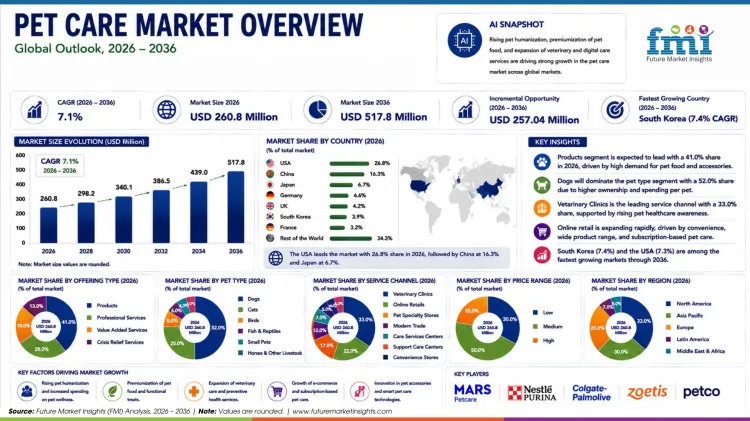
Pet Care Market Dogs Lead Pet Type Segment at 52.0% The global pet care market is forecast to increase from USD 260.8 billion in 2026 to USD 517.8 billion by 2036, expanding at a 7.1% CAGR during the 2026-2036 forecast period, according to Future Market Insights. The market was valued at USD 243.5 billion in 2025. Growth is being supported by continued pet ownership, increasing...
Market Overview The hydrogen inhalation unit market is gaining momentum as molecular hydrogen therapy attracts interest from both wellness consumers and clinical researchers exploring its antioxidant potential. These devices generate hydrogen gas for inhalation, purportedly supporting cellular protection against oxidative stress. The Hydrogen Inhalation Unit Market is projected to expand...

Nanoparticle analysis is a critical field that involves the characterization of nanoparticles—particles with dimensions between 1 and 100 nanometers—for applications in pharmaceuticals, materials science, electronics, and environmental monitoring. Accurate analysis of particle size, shape, concentration, and surface properties is essential for ensuring product quality, safety, and...
The Workspace As A Service market is on a robust growth trajectory, with projections indicating a substantial expansion from a market size of $52.75 billion in 2024 to an impressive $210.2 billion by 2035. This remarkable ascent translates to a CAGR of 13.39%, driven by evolving work models and technological advancements. As hybrid work becomes the norm, organizations are increasingly seeking...

Deploying advanced enzymatic catalysis, green chemistry protocols, and automated quality control testing is transforming production efficiency across the India Atorvastatin API Market. Process chemistry research focuses on optimizing multi-step organic synthesis routes, specifically the chiral reduction steps required to form the active enantiomeric structure of atorvastatin calcium. Utilizing...