Comprehensive Strategic Evolution of Deterministic Industrial Communications and Ruggedized Network Switching Architectures
Modern industrial automation, smart manufacturing ecosystems, and critical energy utility infrastructure rely directly on robust, deterministic local-area transmission backbones, establishing the strategic foundation of the Industrial Ethernet Switch Industry. As traditional manufacturing plants transition away from isolated serial fieldbus systems toward integrated Industry 4.0 architectures, industrial Ethernet switches function as the vital hardware nexus connecting field sensors, programmable logic controllers (PLCs), human-machine interfaces (HMIs), and enterprise resource planning systems. Unlike standard commercial-grade enterprise switches engineered strictly for climate-controlled server rooms, industrial Ethernet switches are purpose-built to operate continuously within severe physical environments characterized by extreme thermal variations, severe mechanical vibrations, sustained mechanical shocks, and high electromagnetic interference. By delivering low-latency packet switching, deterministic priority queues, and redundant media recovery, these ruggedized network appliances ensure operational continuity across modern industrial landscapes.
The foundational engineering of industrial Ethernet switches centers on physical hardware hardening, ingress protection, and thermal dissipation architectures. Industrial switches feature fanless convection-cooling enclosures constructed from heavy-gauge extruded aluminum or cast metal alloys, functioning as continuous heatsinks that prevent internal silicon thermal throttling across wide operating temperature envelopes ranging from minus forty to plus seventy-five degrees Celsius. Internally, printed circuit boards feature conformal coatings to resist ambient moisture condensation, airborne chemical corrosives, and conductive industrial dust, achieving IP30, IP40, or ruggedized IP67 ingress protection ratings. Electrically, internal power supply stages integrate redundant direct-current power inputs, reverse-polarity safeguards, and surge suppression stages certified to IEC 61000-4 standards. This robust design shields the internal switching fabric from voltage spikes, inductive motor kickbacks, and electrostatic discharge common in heavy industrial facilities.
Deploying industrial switches delivers immediate operational advantages across high-demand automation sectors, including automotive assembly plants, oil and gas refineries, smart transportation corridors, and renewable energy facilities. In smart rail networks and trackside signaling installations, EN 50155-certified industrial switches equipped with vibration-resistant M12 locking connectors ensure uncompromised data transmission for passenger information displays, automated train control systems, and closed-circuit security cameras despite relentless physical vibrations. In electrical power substations complying with the rigorous IEC 61850-3 and IEEE 1613 benchmarks, industrial Ethernet switches deliver microsecond-level clock synchronization across protective relays and merging units via the Precision Time Protocol (IEEE 1588v2). This precision timing enables rapid automated fault isolation and prevents cascading power grid failures during high-voltage switching transients.
Looking toward strategic long-term automation roadmaps, industrial Ethernet switching is converging with Time-Sensitive Networking (TSN) standards, single-pair Ethernet (SPE), and cybersecurity hardening frameworks. TSN enhancements—standardized under IEEE 802.1—introduce deterministic latency, guaranteed bandwidth reservation, and time-aware traffic scheduling over standard Ethernet lines. This breakthrough allows critical hard-real-time industrial motion control data to traverse the exact same physical cable infrastructure as standard high-bandwidth video surveillance streams and cloud analytics telemetry without packet collisions or unpredictable transmission delays. Supported by defense-in-depth cybersecurity protocols aligned with IEC 62443 industrial security standards, modern industrial Ethernet switches have evolved from simple network traffic managers into intelligent, resilient communication gateways that power worldwide industrial automation.
Top Trending Reports :
Digital Light Processing Chipset Market
Digital Temperature And Humidity Sensor Market
Categorias
Leia mais
Law Enforcement Software Market Overview The Law Enforcement Software Market report provides an in-depth analysis that is required to make informed industry decisions and develop strategic growth plans. Regardless of the production method or cost structures, the Law Enforcement Software market report provides a comprehensive understanding of advanced tactics and...

According to Market Research Future, cryogenic cooling equipment encompasses the diverse technologies achieving cryogenic temperatures for scientific, medical, and industrial applications. The market's 12.50% CAGR reflects growing demand across quantum computing, space exploration, and healthcare. Understanding Cryogenic Equipment Cryogenic cooling equipment includes all systems achieving...

In retail, shelf space is a finite and valuable resource. Every product placement decision affects visibility, sales, and customer experience. Planogram software—tools that help retailers design, manage, and optimize product layouts—has evolved from simple diagramming aids to sophisticated platforms powered by data analytics and AI. As retail competition intensifies and omnichannel...
The continuous shrinking of integrated circuit physical geometries into sub-3nm nodes, coupled with the introduction of complex 3D gate-all-around (GAA) nanosheet architectures, has made nanoscale defect control the decisive determinant of front-end semiconductor fabrication yields. As feature sizes diminish, even sub-10nm airborne particles, organic residues, metallic trace impurities, or...
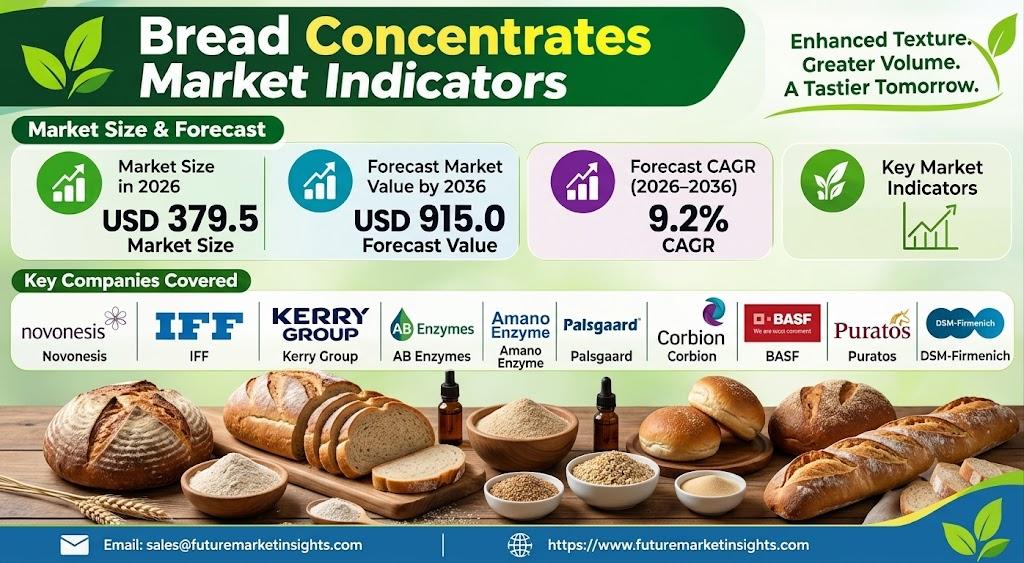
NEWARK, Del., October 30, 2026 The global bread concentrates market is gaining momentum as commercial bakeries, industrial bread manufacturers, and food ingredient suppliers seek solutions that improve production efficiency, product consistency, and formulation flexibility. Growing demand for convenient bakery ingredients, standardized bread quality, and efficient large-scale manufacturing is...