Variable Shunt Reactor Systems Market to Reach $3.90 Billion
The variable shunt reactor systems market covers the reactive power compensation equipment that absorbs or supplies reactive power dynamically to hold voltage within limits as grid conditions change. According to Market Research Future, the market was valued at $2.28 billion in 2024 and is projected to reach $3.896 billion by 2035, expanding at a compound annual growth rate of 4.99% over the forecast period. That growth rate reflects a market driven less by load growth alone than by the control problem that renewable integration creates: variable shunt reactors are becoming essential in maintaining voltage levels and improving overall reliability of electrical systems, and they play a crucial role in managing fluctuations in power supply from intermittent sources such as wind and solar.
Report Key Statistics
Insights published by Market Research Future reveal a market segmented by reactor type, application, voltage level, cooling method, and installation type. By reactor type, air core reactors hold the largest market share and are projected to reach $1.2 billion by 2035 on lightweight construction and enhanced performance in high-variable operating conditions, iron core reactors are projected at $1.5 billion, and HVDC shunt reactors are the fastest-growing segment on efficiency in high voltage applications. By application, power generation holds the largest share and is projected at $1.2 billion, while power distribution is the fastest-growing segment fueled by investments in smart grid technologies and renewable energy integration, and industrial applications show promise as industries shift toward advanced electronic systems. By voltage level, below 100 kV holds the largest share driven by widespread applications in distribution systems and lower voltage networks, the 100–200 kV segment is projected at $1.12 billion, and above 400 kV is the fastest-growing on high-capacity transmission needs. By cooling method, oil-immersed dominates on thermal management and heat dissipation, with both oil-immersed and water-cooled methods projected to reach $1.2 billion, while dry-type grows fastest on environmental friendliness and reduced leakage risk. By installation type, indoor holds the largest share on flexibility and protection from environmental factors, while outdoor grows fastest on cost-effectiveness and scalability, and GIS installation types are projected to reach $1.5 billion. Regionally, North America holds approximately 40% of global market share, Europe around 30%, Asia-Pacific approximately 25%, and the Middle East and Africa about 5%.
Industry Trends
Findings from Market Research Future identify the growing demand for grid stability as a defining trend. As energy systems become more complex, utilities are increasingly relying on these reactors to manage voltage levels and ensure reliable power delivery. A second trend is technological advancement: recent innovations in reactor design are contributing to improved efficiency and reduced footprint, and these advancements enable better performance and lower operational costs, making variable shunt reactors more attractive to end-users, with advances in control systems and materials enhancing performance and allowing better integration with smart grid technologies for real-time monitoring and adjustment of reactive power levels. Third, regulatory support for energy efficiency is creating a favorable environment, as government policies aimed at promoting energy efficiency are likely to encourage adoption, with regulations often including incentives for utilities to invest in reactive power management solutions.
Challenges
The market's growth path involves real friction. Initial installation costs for advanced reactor systems are substantial, and the investment case depends on voltage stability benefits that are difficult to monetize directly in markets where reactive power is not separately compensated. The expansion of transmission and distribution networks, while a driver, requires substantial capital allocation that competes with other grid investments. Technological innovation cycles create specification risk, since control systems specified today may be superseded within the asset's multi-decade service life. Regulatory frameworks vary considerably by jurisdiction, creating uneven demand conditions, and the Middle East and Africa region, holding approximately 5% of global market share, illustrates how regulatory maturity shapes adoption pace.
Future Outlook
Analysis presented by Market Research Future identifies several opportunities. Increasing renewable energy integration is a significant driver, with the share of renewables in the energy mix projected to reach 50% by 2030, necessitating advanced solutions like variable shunt reactors to ensure reliable power delivery. Rising demand for power quality improvement is critical as industrial and commercial entities increasingly rely on sensitive electronic equipment, with market data suggesting the market is expected to grow at a compound annual growth rate of over 6% in the coming years. Expansion of transmission and distribution networks presents substantial opportunity, with investments in transmission and distribution infrastructure projected to exceed $300 billion annually over the next decade. Development of advanced digital control systems for enhanced performance aligns with the integration of smart grid technologies, and expansion into emerging markets with tailored solutions for local grid challenges addresses regions where installed bases remain small.
Expert Discussion
Industry practitioners describe a dynamic competitive landscape driven by increasing demand for efficient power management solutions and growing emphasis on renewable energy integration. Siemens AG, General Electric, Schneider Electric, ABB Ltd, Mitsubishi Electric, Eaton Corporation, Toshiba Corporation, and Hitachi are the principal players. Siemens focuses on innovation in smart grid technologies. General Electric emphasizes digital transformation and the development of advanced grid solutions. ABB is actively pursuing partnerships to enhance product offerings, particularly in the context of sustainability and energy efficiency. In August, Siemens announced a strategic partnership with a leading renewable energy firm to develop integrated solutions for variable shunt reactors, aiming to enhance efficiency of power systems particularly in regions with high renewable penetration. In September, General Electric unveiled a new digital platform designed to optimize performance of variable shunt reactors in real-time, leveraging artificial intelligence to predict maintenance needs and improve operational efficiency. In July, ABB expanded its manufacturing capabilities in Asia to cater to growing demand in emerging markets, enhancing production capacity and allowing quicker response times to regional needs. Companies are localizing manufacturing to reduce costs and enhance supply chain efficiency in a moderately fragmented market.
Conclusion
The variable shunt reactor systems segment is positioned for steady growth, supported by renewable integration and by the voltage control problems that intermittent generation creates. Emerging opportunities lie in digital control systems, emerging market grid reinforcement, and integrated reactive power solutions. Technological development will focus on real-time monitoring capability, compact designs, and the control electronics that allow dynamic response to changing grid conditions. The long-term outlook is one of sustained expansion as grids absorb higher shares of variable generation. Where capital-intensive markets such as the US Water Desalination Market are shaped by large project awards, variable shunt reactor systems compete on the voltage stability they deliver across networks where a single uncontrolled event can cascade into wide-area disruption.
Kategorien
Mehr lesen
For patients with chronic conditions, adherence to daily medication is a constant challenge. Missed doses can reduce effectiveness, worsen outcomes, and increase healthcare costs. Sustained release injectables offer a solution: a single injection that delivers medication over weeks or months, eliminating the need for daily dosing. This approach is transforming treatment for schizophrenia,...

Gram staining remains one of the most fundamental techniques in microbiology, allowing laboratories to rapidly differentiate bacteria into Gram-positive and Gram-negative categories. While the method itself has been around for well over a century, the systems that support it—kits, reagents, and automated equipment—are evolving quickly. This evolution is driving steady expansion...
Surging global incidence of Type 1 and severe Type 2 diabetes, expanding clinical adoption of continuous glucose monitoring (CGM) integration, and consumer preference for automated tubeless delivery devices are driving rapid growth across the global Diabetes Insulin Pumps Market. Insulin pumps—comprising traditional durable tubed pumps and discreet wearable tubeless patch...
The Mobile Mapping Market is experiencing robust global adoption driven primarily by the accelerating development of smart cities, comprehensive urban planning initiatives, and large-scale transportation infrastructure projects that demand precise, up-to-date geospatial data to support informed decision making and efficient resource allocation. As the world's urban population continues to grow,...

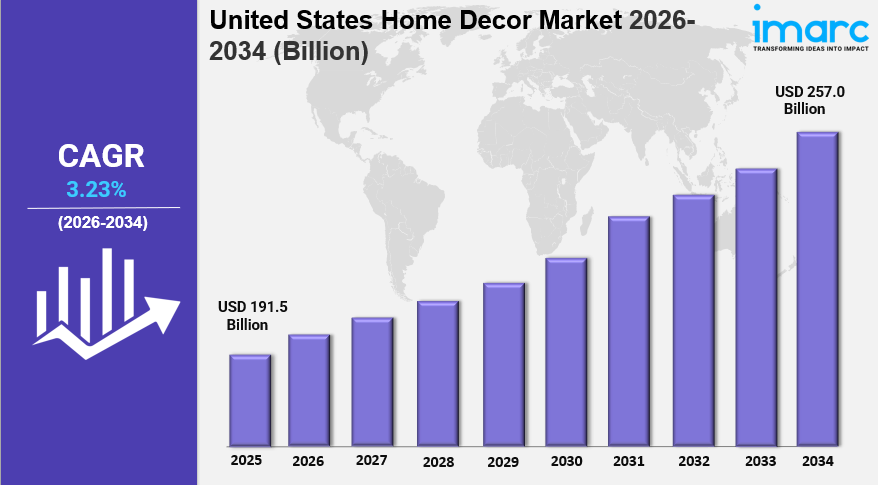
The latest report by IMARC Group, titled "United States Home Decor Market Size, Share, Trends and Forecast by Product Type, Distribution Channel, and Region, 2026-2034", offers a comprehensive analysis of the industry, which comprises insights on the United States home decor market. The report also includes competitor and regional analysis. United States Home Decor Market Size Overview and...