Three Phase Shunt Reactors Market to Reach $2.64 Billion by 2035
The three phase shunt reactors market covers the reactors connected in parallel with transmission and distribution circuits to absorb capacitive reactive power and hold voltage within acceptable limits, particularly on lightly loaded lines and cables where capacitance would otherwise drive voltage above nominal. According to Market Research Future, the market was valued at $1.71 billion in 2024 and is projected to reach $2.636 billion by 2035, expanding at a compound annual growth rate of 4.01% over the forecast period. That growth rate reflects a market driven less by unit volume than by the control problem that modern grids create: as electrical grids become more complex, the necessity for reactive power compensation has surged, leading to heightened interest in shunt reactors that stabilize voltage levels and enhance overall reliability of power systems.
Report Key Statistics
Insights published by Market Research Future reveal a market segmented by voltage rating, phase, cooling type, application, and mounting type. By voltage rating, medium voltage from 1kV to 33kV holds the largest share with a valuation between $0.5 and $0.75 billion, reflecting strong adoption across industrial applications where reliability and efficiency are paramount, while high voltage from 33kV to 132kV is the fastest-growing segment driven by increasing demand for renewable energy integration and substantial investments in high-capacity transmission infrastructure, low voltage from 0.4kV to 1kV is valued between $0.3 and $0.45 billion, and extra-high and ultra-high voltage serve long-distance transmission. By phase, three phase dominates with a valuation between $1.21 and $1.886 billion due to widespread adoption across power systems requiring efficient reactive power management, while single phase, though smaller at $0.5 to $0.75 billion, gains traction as industries look for cost-effective solutions in less complex setups. By cooling type, oil immersed holds the largest share with a valuation range of $0.5 to $0.75 billion on thermal management efficiency and reliability in high-performance environments, while dry type grows on environmental concerns and safer installation practices that minimize fire hazards. By application, power factor correction holds the largest share on its critical role in enhancing electrical system efficiency, while voltage regulation is the fastest-growing segment at valuations ranging from $0.3 to $0.76 billion, driven by demand for stable power supply in the context of renewable integration, with harmonic filtering and resonance compensation contributing. By mounting type, floor mounted holds the largest share on stability and ease of installation, while pole mounted is valued between $0.81 and $1.18 billion and gains attention on space-saving attributes and adaptability to compact environments. Regionally, North America holds approximately 40% of global market share, Europe around 30%, Asia-Pacific approximately 25%, and the Middle East and Africa about 5%.
Industry Trends
Findings from Market Research Future identify rising demand for renewable energy integration as a defining trend. The integration of renewable energy sources into existing power grids is driving the need for effective reactive power management, and shunt reactors are essential in stabilizing voltage levels, thus facilitating the smooth incorporation of intermittent energy sources like wind and solar. A second trend is technological advancement in reactor design: recent innovations in materials and engineering are enhancing efficiency and durability, and these advancements may lead to more compact designs, which could be particularly appealing for modern applications requiring space-saving solutions. Third, increased focus on grid reliability and stability is intensifying, as electrical grids face growing complexities and shunt reactors become increasingly vital in ensuring consistent voltage levels, thereby supporting the overall integrity of power systems.
Challenges
The market's growth path involves real friction. Oil immersed reactors dominate on thermal performance but carry fire and environmental considerations that are driving the shift toward dry type units, which cost more per unit capacity. Extra-high and ultra-high voltage reactors require advanced engineering that limits the number of qualified suppliers, extending lead times when multiple regions upgrade simultaneously. Reactive power has historically not been separately compensated in many markets, meaning the economic case for investment rests on avoided voltage violations and regulatory compliance rather than direct revenue. Insulation coordination and loss evaluation are becoming more demanding as transmission voltages rise, and manufacturers must balance loss minimization against material cost.
Future Outlook
Analysis presented by Market Research Future identifies several opportunities. The growing need for voltage regulation is a primary driver, with the market projected to expand as utilities seek solutions to maintain voltage levels within acceptable limits, and in 2025 the market is expected to witness a growth rate of approximately 6% annually driven by enhanced voltage control needs in transmission networks. Expansion of transmission infrastructure is critical, with the market expected to contribute growth of around 5% as utilities prioritize investments in reliable and efficient transmission systems, and in many regions construction of new transmission lines is accompanied by installation of shunt reactors to counteract capacitive loads. Regulatory support for energy efficiency is emerging as a significant driver, with market growth of around 4% expected as utilities align with governmental mandates. Rising adoption of smart grid technologies is influencing the market with a growth trajectory of approximately 7%, as smart grids facilitate better monitoring and management of electricity flow, enhancing the need for reactive power compensation. Increased investment in renewable energy sources is pivotal, with the market anticipated to grow by approximately 8% as utilities and energy producers recognize the necessity of integrating shunt reactors to accommodate increasing shares of renewables.
Expert Discussion
Industry practitioners describe a dynamic competitive landscape driven by increasing demand for efficient power management solutions and growing emphasis on renewable energy integration. Siemens, General Electric, Schneider Electric, ABB, Mitsubishi Electric, Eaton, Toshiba, CG Power and Industrial Solutions, and Nexans are the principal players. Siemens focuses on innovation and digital transformation, aiming to enhance operational efficiency through smart grid technologies, and in August announced the launch of a new line of shunt reactors designed specifically for renewable energy applications, aligning with the global push for sustainability and positioning Siemens as a leader in facilitating integration of renewable sources. General Electric emphasizes partnerships and collaborations to expand market reach particularly in emerging economies, and in September entered a strategic partnership with a leading renewable energy firm to co-develop advanced shunt reactor technologies, allowing it to leverage its partner's expertise and expand market presence. ABB is actively pursuing mergers and acquisitions to bolster its product portfolio, and in July completed the acquisition of a regional player specializing in shunt reactor manufacturing, expanding its product portfolio and enhancing manufacturing capabilities in key markets, with integration expected to streamline operations and improve competitive positioning. Companies are localizing manufacturing to reduce costs and enhance supply chain resilience, and the market is moderately fragmented with regional players also exerting influence.
Conclusion
The three phase shunt reactors market is positioned for steady growth, supported by voltage regulation requirements and by the reactive power management that renewable integration demands. Emerging opportunities lie in advanced insulation materials, emerging market infrastructure, and IoT integration for real-time monitoring and maintenance. Technological development will focus on compact designs, dry-type insulation, and the monitoring capability that supports condition-based maintenance. The long-term outlook is one of sustained expansion as grids absorb higher shares of variable generation and as transmission networks extend to connect remote resources. Where capital-intensive markets such as the US Water Desalination Market are shaped by large project awards, three phase shunt reactors compete on the voltage stability they maintain across networks where a single uncontrolled excursion can cascade into wide-area disruption.
Categorii
Citeste mai mult
Market Overview Flexible and video single-use bronchoscopes are improving visualization, maneuverability, and procedural efficiency across respiratory care. These devices enable clinicians to examine airways, collect samples, and perform selected treatments without relying exclusively on reusable equipment. Market Research Future projects growth from USD 2,048.89 million in 2024 to USD 4,739.46...

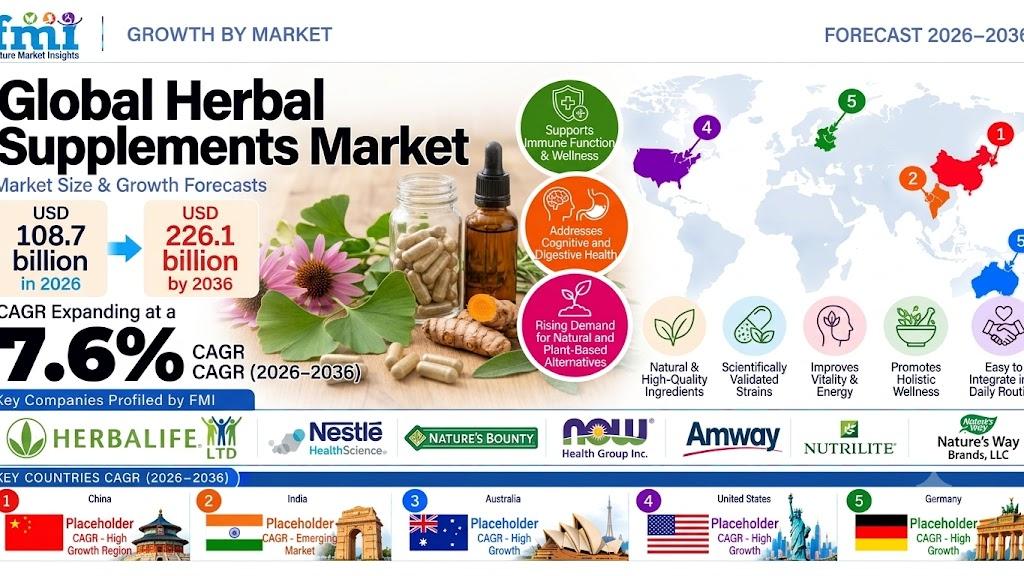
NEWARK, Del., October 22, 2026 — The global Herbal Supplements Market is gaining momentum as consumers increasingly incorporate botanical ingredients into their daily wellness routines and seek convenient products for preventive health and general well-being. According to the latest market intelligence report published by Future Market Insights (FMI), the market is valued at USD 108.7...
Market Overview The recombinant collagen market is expanding as biotechnology advances enable production of animal-free, highly purified collagen proteins for medical devices, wound care, and cosmetic applications. Produced through genetically engineered microbial or yeast systems, recombinant collagen offers batch consistency and reduced immunogenicity compared to traditional animal-derived...
Pot Pies Market Demand for Convenient Meals Increases NEWARK, Del., October 26, 2026 — The global pot pies market is gaining momentum as food manufacturers, frozen meal producers, retailers, and foodservice operators respond to demand for convenient, ready-to-prepare savory meals. According to the latest market intelligence report published by Future Market Insights (FMI), the global pot...

Artificial intelligence has changed the way people write. Tools such as Claude can help create articles, reports, emails, study notes, and marketing content in seconds. That convenience is useful, but it also creates a new question: How can you tell whether a piece of writing was produced by AI? This is where a Detector IA Claude can become useful. Instead of relying only on how polished or...