


China Offshore Platform Abandonment: Regulatory Frameworks and Engineering Solutions

According to Market Research Future, China offshore platform abandonment activity is accelerating as the nation's offshore oil and gas estate matures. The broader China offshore decommissioning market, valued at USD 457.5 million in 2024, is projected to reach USD 1,012 million by 2035 at a 7.48% CAGR, with platform abandonment representing a substantial portion of this expenditure.
Understanding Platform Abandonment
Platform abandonment encompasses the complete process of ceasing operations and permanently retiring an offshore structure. Unlike temporary shutdowns, abandonment involves regulatory notification, engineering planning, physical removal or reefing, and environmental verification.
Regulatory Framework
China's abandonment regime has evolved considerably, drawing on international best practices while reflecting domestic priorities:
Notification Requirements: Operators must formally notify regulators of abandonment intentions and submit detailed plans.
Environmental Assessment: Comprehensive evaluation of ecological impacts, including effects on fisheries and marine habitats.
Technical Justification: Documentation demonstrating that continued operation is uneconomical or unsafe.
Removal Standards: Specifications governing how much structure must be removed versus left in place.
Financial Assurance: Requirements ensuring operators have resources to complete abandonment obligations.
Engineering Approaches
Full Removal: Complete extraction of topsides, jacket, and piles to mudline, restoring the seabed to pre-development conditions.
Partial Removal: Leaving portions of structure below a specified depth to serve as artificial reefs while ensuring navigational clearance.
Refloating and Relocation: For some structures, refloating and moving to new locations or shore facilities for dismantling.
In-Situ Decommissioning: Limited circumstances where structures remain in place after thorough cleaning and isolation.
Drivers Accelerating Abandonment Activity
Aging Asset Base
Many Chinese offshore platforms have operated for three decades or more, exceeding original design parameters. Continued maintenance becomes increasingly costly and technically challenging.
Environmental Regulations
Stricter enforcement of environmental standards compels operators to address aging infrastructure rather than deferring action indefinitely.
Economic Rationality
Marginal fields become uneconomical as production declines and operating costs rise, making abandonment the rational business decision.
Energy Transition Pressures
China's commitment to carbon reduction and renewable energy expansion creates incentives to retire fossil fuel infrastructure systematically.
Service Segments Shaping Abandonment
Well Plugging and Abandonment
The largest segment, involving permanent isolation of wellbores to prevent leakage. Valued between USD 45.75 million and USD 104.4 million, this work is fundamental to environmental protection.
Site Clearance Growth
Site clearance is emerging as the fastest-growing segment, reflecting emphasis on thorough restoration and regulatory compliance.
Shallow Water Versus Deepwater
Shallow water abandonment dominates, while deepwater activity grows as complex facilities age.
Regional Dynamics
Abandonment activity concentrates in the Bohai Bay, where many early installations reside, and the South China Sea, where aging infrastructure increasingly requires attention. Service providers establish regional bases near key operational areas.
Competitive Landscape
International majors including Halliburton, Petrofac, and Saipem compete with domestic Chinese providers. Competition focuses on technical capability, environmental performance, and regulatory familiarity.
Challenges Constraining Abandonment
Regulatory Uncertainty: Evolving requirements create planning challenges.
Technical Complexity: Deepwater and complex structures present engineering difficulties.
Environmental Sensitivities: Marine ecosystems require careful protection throughout abandonment operations.
Cost Management: Abandonment costs can be substantial, requiring careful budgeting and financial planning.
Future Outlook
China offshore platform abandonment appears positioned for sustained growth driven by aging infrastructure and tightening regulations. Opportunities include advanced robotic systems, sustainable material disposal, and specialized engineering consultancy.
Conclusion
China offshore platform abandonment represents a growing and essential segment of the offshore services industry. As the nation's offshore estate matures, demand for capable abandonment contractors will continue rising, creating opportunities for firms combining technical excellence with environmental responsibility.
Dive into related studies for a broader industry perspective:
Inertial Systems Energy Infrastructure Industry
UK Atmospheric Water Generator Industry
South Korea Atmospheric Water Generator Industry
Germany Atmospheric Water Generator Industry
Japan Atmospheric Water Generator Industry
North America Atmospheric Water Generator Industry
South America Atmospheric Water Generator Industry
Europe Atmospheric Water Generator Industry
Categorii
Citeste mai mult
Drug discovery requires a detailed understanding of how candidate compounds affect biological systems. Researchers frequently investigate proteins involved in inflammation, cellular signaling, metabolism, and disease progression to evaluate potential therapeutic effects. Protein multiplex assays are helping pharmaceutical research teams analyze multiple biological targets in parallel,...

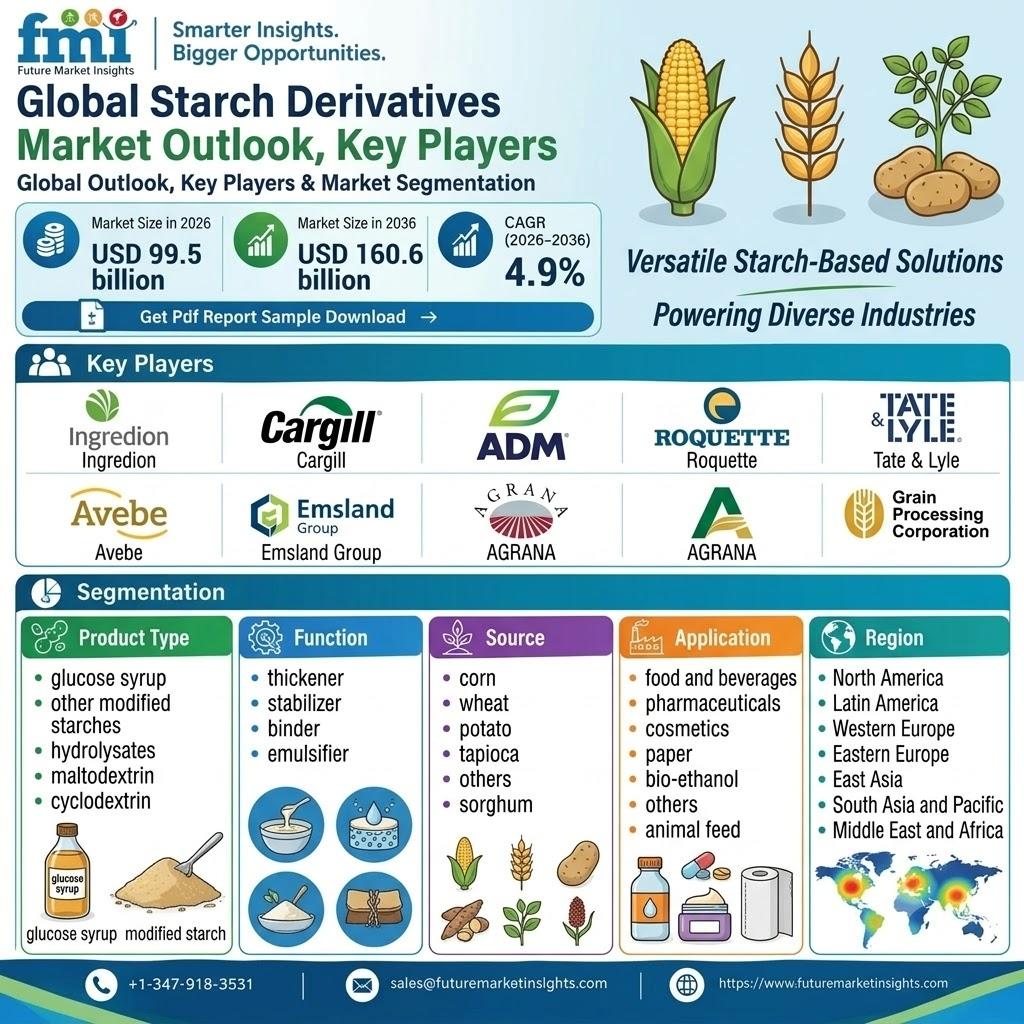
NEWARK, Del., October 8, 2026. — The global starch derivatives market is estimated at USD 99.5 billion in 2026 and is projected to reach USD 160.6 billion by 2036, expanding at a CAGR of 4.9% from 2026 to 2036, according to Future Market Insights (FMI). The market stood at USD 94.9 billion in 2025. The growth outlook is being shaped by rising production of processed food, beverages, paper...
Market Overview The horse chestnut seed dry extract market is accelerating as botanical therapeutics gain recognition for supporting chronic venous insufficiency and vascular health across European and expanding global markets. Clinicians and consumers are seeking standardized phytomedicines that offer edema reduction and anti-inflammatory benefits with favorable safety profiles. The Horse...
Surging global surgical procedure volumes, expanding hospital infection control mandates, and continuous material science transitions from traditional woven cotton gauze to high-performance synthetic non-woven fabrics are driving robust expansion across the global Non Woven Sponge Market. Non-woven sponges—comprising multi-ply absorbent swabs and sponges fabricated from hydroentangled...
Market Overview The South Korea laboratory automation market is benefiting from system integration advances that enable seamless workflow connectivity between automated instruments, laboratory information systems, and hospital information systems. Integrated automation creates end-to-end workflow efficiency and comprehensive data management capabilities. The South Korea Laboratory Automation...