Deep Dive Engineering Comparative Assessment of Cost Effective 8 Bit Against High Performance 32 Bit RISC Platforms
Designing dependable, power-efficient embedded electronic systems requires balancing processing throughput, non-volatile memory footprint, physical silicon real estate, peripheral integration density, and unit bill-of-materials costs, engineering criteria examined within the Microcontroller Unit Market Analysis. When embedded firmware engineers and hardware systems architects select microcontroller platforms for consumer appliances, automotive sub-systems, or industrial IoT nodes, they must evaluate the fundamental operational trade-offs between mature, cost-effective 8-bit architectures and modern, high-performance 32-bit RISC processor platforms. Evaluating how these contrasting silicon topologies handle memory addressing limits, process complex mathematical arrays, manage interrupt latency jitter, and consume electrical current during sleep and active states is critical for engineering reliable embedded hardware.
The primary architectural distinction between 8-bit and 32-bit microcontrollers lies in internal register bus widths, arithmetic logic unit (ALU) data processing bandwidth, and memory addressing limits. An 8-bit microcontroller (such as classic 8051, PIC, or AVR cores) processes data in single-byte chunks. Its internal registers, data buses, and ALU are eight bits wide, and its linear memory address space is fundamentally constrained, traditionally limited to 64 kilobytes unless complex, bank-switching memory paging schemes are implemented. Processing a 32-bit integer or floating-point mathematical calculation on an 8-bit MCU requires the compiler to break the operation into multiple multi-cycle machine instructions, consuming dozens of clock cycles. In contrast, a 32-bit MCU (such as an Arm Cortex-M or RISC-V core) features 32-bit registers, a unified 32-bit linear address space capable of directly accessing four gigabytes of physical memory, and single-cycle hardware multipliers that process wide mathematical operations in a single clock cycle.
From an interrupt handling, real-time determinism, and software development complexity perspective, 8-bit microcontrollers retain distinct engineering advantages for simple, highly deterministic control routines. The microarchitecture of an 8-bit MCU is straightforward, featuring shallow instruction pipelines (often only two or three stages) and minimal internal state overhead. When an external hardware interrupt triggers, the 8-bit MCU responds with minimal, predictable interrupt latency jitter, making it well-suited for strict bit-banging communication protocols, simple timer-based trigger events, and direct GPIO pin toggling. Furthermore, 8-bit microcontrollers are exceptionally easy to program and debug at the bare-metal assembly or C level without requiring complex real-time operating systems (RTOS). However, as modern applications require complex software stacks—such as TCP/IP networking, USB device drivers, BLE protocol stacks, and graphical touch displays—the limited memory and computational throughput of 8-bit devices quickly become bottlenecks, requiring 32-bit architectures.
Furthermore, analyzing operating power consumption and energy-per-task dynamics dispels the traditional assumption that 8-bit MCUs are always more power-efficient than 32-bit alternatives. While an 8-bit microcontroller typically exhibits a lower active clock current draw at low operating frequencies (e.g., drawing microamperes at 1 MHz), its limited ALU bandwidth forces it to remain awake for hundreds of clock cycles to compute complex mathematical algorithms or process sensor payloads. A 32-bit microcontroller operating at a higher clock frequency (e.g., 48 MHz to 100 MHz) can execute the identical mathematical task in a fraction of the clock cycles and return to an ultra-low-power deep sleep mode in microseconds. This "race-to-sleep" computational paradigm means that for many modern sensor processing tasks, 32-bit microcontrollers achieve lower overall energy-per-task metrics than 8-bit devices, extending battery life in wireless IoT deployments.
Top Trending Reports :
High Dynamic Range Display Market
High End Field Programmable Gate Array Market
High Intensity Discharge Lamps Market
Categories
Read More
The Italy Dercums Disease Market exhibits a dynamic competitive landscape characterized by innovation, strategic partnerships, and technological integration among key players. The market is projected to grow from USD 355.46 million in 2025 to USD 686 million by 2035, registering a CAGR of 6.8% during the forecast period. This growth trajectory reflects the collective efforts of major companies...

The medical tourism market is characterized by a complex and dynamic ecosystem of destinations, service providers, and facilitators that compete to attract international patients. Understanding this landscape requires examining the distinct regional dynamics that make certain countries preferred destinations for specific treatments, as well as the competitive strategies of leading healthcare...
A market addressing a disease that affects millions annually should be growing faster than 11.6%—or should it? The typhoid antibody testing market faces structural constraints that limit its full potential, and understanding them is essential for stakeholders navigating the Typhoid Antibody Testing Market. Diagnostic Accuracy and Cross-Reactivity The primary technical restraint is...
The development and commercial launch of non-hormonal neurokinin-3 (NK3) receptor antagonists represent a landmark therapeutic breakthrough for menopausal symptom management. Detailed analysis within the Menopause Treatment Market report highlights how selective NK3 receptor antagonists target the KNDy (kisspeptin/neurokinin B/dynorphin) neuronal network in the hypothalamus directly. Blocking...
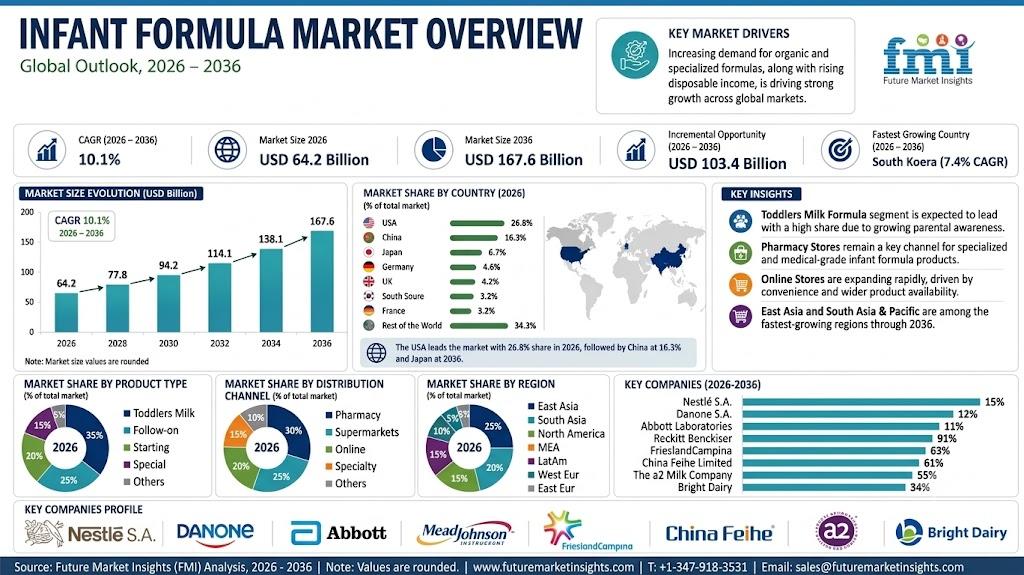
Infant Formula Market Starting Milk Formula Leads Product Type at 50.0% The global infant formula market is forecast to increase from USD 64.2 billion in 2026 to USD 167.6 billion by 2036, expanding at a 10.1% CAGR during the 2026-2036 forecast period, according to Future Market Insights. The market stood at USD 58.3 billion in 2025. Growth is being supported by continued demand for infant...