


Utility Scale Digital Substation Market: The Grid's Digital Reckoning

The substation is where the electrical grid becomes legible. For a century, that legibility was mechanical—relays, copper wiring, analog meters. Today, the Utility Scale Digital Substation Market represents the wholesale replacement of that mechanical logic with digital intelligence, and the financial stakes are enormous. According to Market Research Future, the sector was valued at USD 49.04 billion in 2024 and is projected to reach USD 277.17 billion by 2035, expanding at a CAGR of 17.05%—one of the fastest growth rates in the entire energy infrastructure space. This article explains what is driving that acceleration, which technologies are reshaping substation architecture, and where the market's center of gravity is shifting.
What Makes a Substation "Digital"
A digital substation replaces hardwired analog signal paths with digital communication networks. Instead of copper cables carrying measurement values to protection relays, digital substations use process bus and station bus architectures—typically built on IEC 61850 standards—to transmit sampled values and control commands over fiber.
The practical consequences are substantial:
-
Fewer copper cables means lower installation cost and smaller physical footprint
-
Interoperability allows equipment from multiple vendors to communicate on a common protocol
-
Remote monitoring and control becomes native rather than bolted-on
-
Data becomes available for analytics, predictive maintenance, and grid optimization
This is not an incremental product upgrade. It is an architectural transition that changes how substations are designed, commissioned, operated, and maintained.
The Technology Stack Driving Growth
Three technology layers define the market's evolution.
Protection and automation remains the largest component segment. Digital protection relays, merging units, and substation automation systems form the functional core—ensuring faults are detected and isolated in milliseconds. This layer carries the highest reliability requirements and the deepest vendor entrenchment.
Communications and cybersecurity has moved from supporting function to critical concern. As substations become network-connected, they become attack surfaces. Utility procurement now treats cybersecurity architecture as a primary specification, not a checklist item.
Monitoring and control is the fastest-growing capability area. Real-time visibility into transformer health, breaker performance, and power quality enables condition-based maintenance rather than scheduled maintenance—a direct cost reduction.
Power transformers represent the fastest-growing component segment overall, driven by capacity expansion and the replacement of aging assets alongside digital retrofits.
Analytics and AI: Where Differentiation Lives
The technology segmentation reveals where the market's intellectual center is moving. Big data analytics holds the largest technology share—reflecting that digital substations generate far more data than utilities can use without analytical tooling.
Artificial intelligence is the fastest-growing technology segment. Practical applications are already in production:
-
Predictive maintenance models that identify failing components before failure
-
Fault classification that distinguishes transient disturbances from genuine faults
-
Load forecasting at substation level to inform switching decisions
-
Anomaly detection on sensor streams that would overwhelm human monitoring
Cloud computing and digital simulation round out the technology stack—the former enabling scalable analytics, the latter supporting commissioning and operator training without risk to live equipment.
Application Dynamics
Smart grid holds the largest application share. Digital substations are the foundational layer of grid modernization—without substation-level intelligence, distribution automation and demand response cannot function effectively.
Renewable energy integration is the fastest-growing application. Solar and wind are inverter-based, variable, and often distributed—characteristics that legacy substation architecture handles poorly. Digital substations provide the visibility and control needed to manage bidirectional flows and variable generation.
Transmission and distribution applications remain substantial but are being reshaped by the same digital transition.
Regional Patterns
North America holds approximately 40% of global market share, driven by aging infrastructure replacement, renewable procurement, and regulatory pressure. The United States and Canada lead, with General Electric, Siemens, and Eaton anchoring the competitive landscape.
Europe accounts for roughly 30%, aligned with the EU's carbon neutrality targets. Germany and France are the primary markets, with ABB and Schneider Electric prominent.
Asia-Pacific represents about 20% and is the fastest-growing region. China and India drive demand through urbanization, industrialization, and aggressive renewable buildout, with Mitsubishi Electric and Hitachi Energy active alongside expanding domestic manufacturers.
Middle East and Africa, at approximately 10%, offers frontier opportunity tied to grid modernization and energy diversification, particularly in the UAE and South Africa.
Competitive Landscape
The market is moderately fragmented but led by a concentrated global tier: Siemens, General Electric, Schneider Electric, ABB, Mitsubishi Electric, Hitachi Energy, Eaton, Honeywell, and Rockwell Automation. Recent strategic moves reflect three priorities—AI integration into protection and maintenance, partnerships aligned with renewable transition, and acquisitions targeting digital grid capability.
Conclusion
The utility scale digital substation market is expanding at a rate that reflects urgency rather than opportunism. Grids built for centralized fossil generation are being asked to accommodate distributed renewables, bidirectional flows, and electrified transport—and legacy substation architecture cannot deliver the visibility or control that requires. Growth through 2035 will reward vendors who combine protection reliability with analytics capability and cybersecurity depth. For utilities, the decision is no longer whether to digitize substations, but how quickly they can do so without compromising the reliability that customers expect.
US Floating Solar Panels Market
US Fuel Cell Technology Market
US Fuel Management System Market
Catégories
Lire la suite
Market Overview The Robotic Medical Imaging Market is receiving significant interest from robotic ultrasound systems designed to improve examination consistency and expand access to expert imaging. Conventional ultrasound is highly dependent on the operator’s skill, probe pressure, angle, and ability to identify anatomical structures. Robotic assistance can standardize probe movement and...

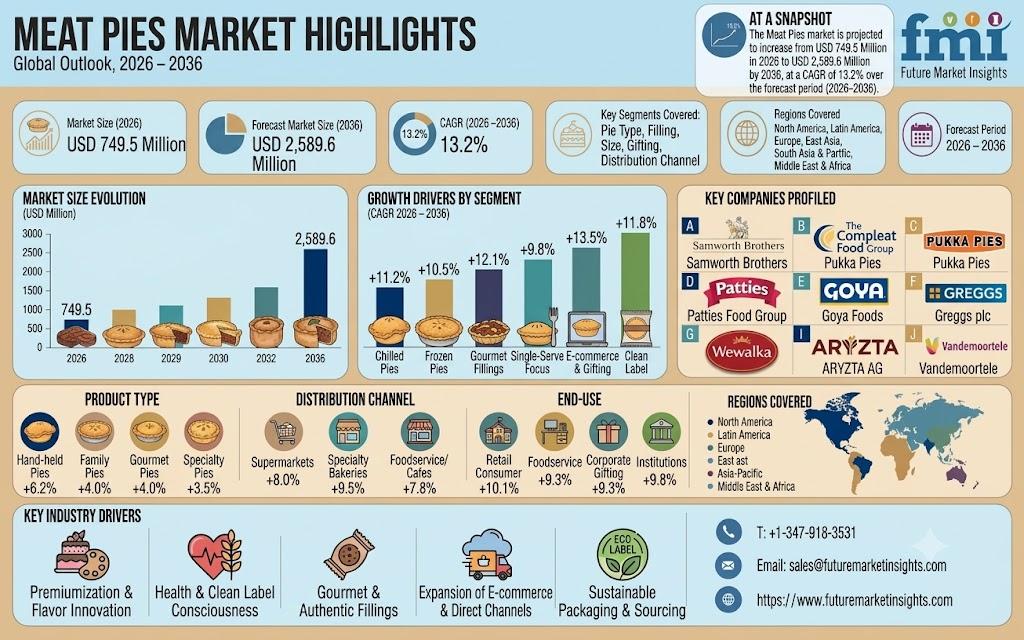
NEWARK, Del., September 25, 2026 According to Future Market Insights (FMI), the Meat Pies Market is projected to grow from sales of meat pies estimated at USD 749.5 million in 2026 to USD 2,589.6 million by 2036, expanding at a 13.2% CAGR. Demand for meat pies is supported by their role as convenient portioned savory foods suited to planned meals and hot food-to-go occasions. Familiar...
According to Market Research Future's competitive analysis, the Pem Electrolyzer Market Share landscape reflects a competitive industry featuring established electrolyzer manufacturers, emerging specialists, and industrial gas majors competing for position in the green hydrogen economy. Market Structure The PEM electrolyzer market exhibits moderate concentration with several major players...

Melanocortin Receptor 4 (MC4R) is a G protein-coupled receptor that plays a critical role in regulating energy balance, appetite, and body weight. It is also involved in pigmentation, sexual function, and cardiovascular regulation. The market for MC4R-targeting therapeutics is expanding rapidly, driven by the rising prevalence of obesity and rare genetic disorders, increasing research...
Regional investment is becoming an important component of the AAV Vector Gene Therapy Market as biotechnology hubs, pharmaceutical companies, academic institutions, and healthcare systems build capabilities around advanced genetic medicine. AAV development requires specialized research infrastructure, manufacturing expertise, clinical capabilities, and regulatory experience, making regional...