Disconnect Switch Market: Safety Devices at the Center of Grid Transformation

Disconnect switches occupy an odd position in electrical engineering: they perform no function during normal operation. A closed disconnect switch simply conducts current, indistinguishable from the cable it connects. Its value appears only during maintenance, emergency isolation, or fault conditions—moments when a technician's life depends on visible, verifiable isolation. The Disconnect Switch Market is therefore shaped by safety regulation, maintenance practice, and infrastructure expansion rather than by everyday energy consumption. According to Market Research Future, the sector was valued at USD 14.39 billion in 2024 and is projected to reach USD 24.85 billion by 2035, expanding at a CAGR of 5.09%. That growth reflects a grid being rebuilt, expanded, and made safer.
Why Isolation Equipment Matters More Now
Three structural changes have raised the importance of disconnect switches.
Renewable generation requires isolation points. Solar and wind installations need to be isolated from the grid for maintenance, inverter service, and fault investigation. Each interconnection point requires switchgear capable of visible isolation.
Grids are becoming more complex. Bidirectional power flows, distributed generation, and energy storage mean that any given circuit may be energized from multiple sources. Isolation must account for all of them—raising specification requirements.
Safety regulation is tightening. Standards governing lockout-tagout procedures, arc-flash protection, and maintenance access increasingly mandate visible disconnection before work proceeds. Compliance drives specification.
The practical consequence is that disconnect switches are being installed in greater numbers and specified to higher standards than in previous grid generations.
The Application Split
The application segmentation reveals where demand originates.
Power generation holds the largest share. Generation facilities—whether fossil, nuclear, or renewable—require isolation equipment for maintenance access to generators, transformers, and auxiliary systems. The requirement is fundamental and non-discretionary.
Transmission and distribution represents the largest value segment by revenue, reflecting the scale of grid infrastructure and the number of isolation points across substations and line equipment. Projections indicate transmission and distribution growing substantially through the forecast period as grid modernization proceeds.
Renewable energy is the fastest-growing application. Solar and wind installations require disconnect switches at multiple points—array level, inverter level, and interconnection level. As renewable capacity expands well above general electricity growth, this segment grows fastest.
Industrial applications represent a significant and expanding segment, driven by manufacturing automation, process safety requirements, and the need to isolate equipment for maintenance without shutting down entire facilities.
Type Dynamics: Where Technology Is Migrating
Double throw switches hold the largest share, valued for reliability and versatility in switching between sources or circuits. Their robust design and consistent performance under varying load conditions make them the default in manufacturing and utility applications.
Manual operated switches are the fastest-growing type by some measures, driven by demand in remote or less accessible locations where automation is impractical and simplicity is an advantage. Manual switches offer low maintenance and direct operator control.
Motor operated switches represent the highest-value type segment, projected to grow substantially as remote operation and automation become standard. Motor operation allows switches to be controlled from control rooms, integrated into SCADA systems, and operated safely without physical proximity to energized equipment.
The trajectory is clear: switchgear is being drawn into the digital control architecture of modern grids, and motor-operated designs capture that trend.
Voltage Segments
Low voltage holds the largest share, reflecting ubiquitous use across residential, commercial, and light industrial applications—fuse disconnects, safety switches, and non-fused disconnects protecting circuits at the point of use.
Medium voltage serves distribution networks and industrial facilities, where isolation requirements are more demanding and equipment is more sophisticated.
High voltage is the fastest-growing voltage segment, projected to grow significantly as renewable interconnection and grid expansion proceed. High-voltage disconnect switches are essential for isolating transmission lines, substations, and large generating facilities—and their per-unit value is substantially higher than lower-voltage equipment.
End-Use Distribution
Residential holds the largest end-use share, driven by safety regulations requiring disconnection at service entrances and by growing adoption of home energy management systems.
Industrial is the fastest-growing end-use segment, projected to grow substantially as manufacturing electrification, automation, and process safety requirements increase. Industrial facilities require isolation equipment at every major piece of equipment—and the number of such installations grows with electrification.
Commercial occupies a middle position, driven by building codes and the growing complexity of commercial electrical systems.
Regional Patterns
North America holds the largest regional share, driven by extensive industrialization, grid modernization investment, and stringent safety regulation. The United States dominates regionally.
Europe follows closely, with stringent safety regulations and a strong shift toward renewable energy driving demand. Germany leads the European market, with offshore wind and grid reinforcement programs supporting growth.
Asia-Pacific is the fastest-growing region, driven by rapid urbanization, industrialization, and infrastructure development in China and India. Grid expansion and electrification programs create substantial demand for disconnect equipment across voltage classes.
South America and Middle East & Africa represent smaller markets with steady growth potential, tied to grid infrastructure investment and electrification programs.
Competitive Landscape and Recent Moves
The market is characterized by a dynamic competitive landscape among major electrical equipment manufacturers—Siemens, Schneider Electric, General Electric, Eaton, Mitsubishi Electric, ABB, Rockwell Automation, Toshiba, and Hitachi.
Recent strategic activity reveals three priorities: smart grid technology collaboration (Siemens), portfolio expansion through joint ventures targeting energy solutions (Eaton), and acquisition of specialized power technology capability (Mitsubishi Electric). The industry trend is toward IoT integration, remote monitoring, and eco-friendly insulation technology as environmental regulations tighten.
Conclusion
The disconnect switch market grows because grids are expanding, renewable generation requires isolation points, and safety regulation keeps raising the specification bar. Growth at a compound rate through 2035 will reward manufacturers who can deliver motor-operated and smart-capable designs, high-voltage equipment for transmission applications, and environmentally compliant insulation technology. The switch itself remains a simple device—but the role it plays in a complex, bidirectional, safety-regulated grid has become considerably more important.
US Oilfield Equipment Rental Services Market
US Outage Management System Market
US Portable Solar Charger Market
US Solar Hybrid Inverter Market
US Solar Street Lighting Market
Categorias
Leia mais
Market Overview The gastrointestinal stent market is growing as minimally invasive endoscopic techniques increasingly replace open surgery for managing benign and malignant strictures across the digestive tract. Gastrointestinal stents provide palliative relief and bridge-to-surgery solutions for esophageal, colonic, and biliary obstructions, improving patient quality of life while reducing...

Widespread generic availability following loss of exclusivity for brand-name SNRI formulations is reshaping market accessibility across developing healthcare markets. Detailed analysis within the Venlafaxine Market report indicates that active pharmaceutical ingredient (API) synthesis optimizations, automated encapsulation lines, and generic bioequivalence validation are driving high-volume...
The Mobile Mapping Market is experiencing robust global adoption driven primarily by the accelerating development of smart cities, comprehensive urban planning initiatives, and large-scale transportation infrastructure projects that demand precise, up-to-date geospatial data to support informed decision making and efficient resource allocation. As the world's urban population continues to grow,...

Walk into almost any pharmacy worldwide and you'll find quinolones — and in the vast majority of cases, they'll be generics. Ciprofloxacin, levofloxacin, ofloxacin, and moxifloxacin are produced by dozens of manufacturers across India, China, Europe, and the Americas. This generic dominance defines the economics of the quinolone market: high volumes, low prices, and intense competition,...
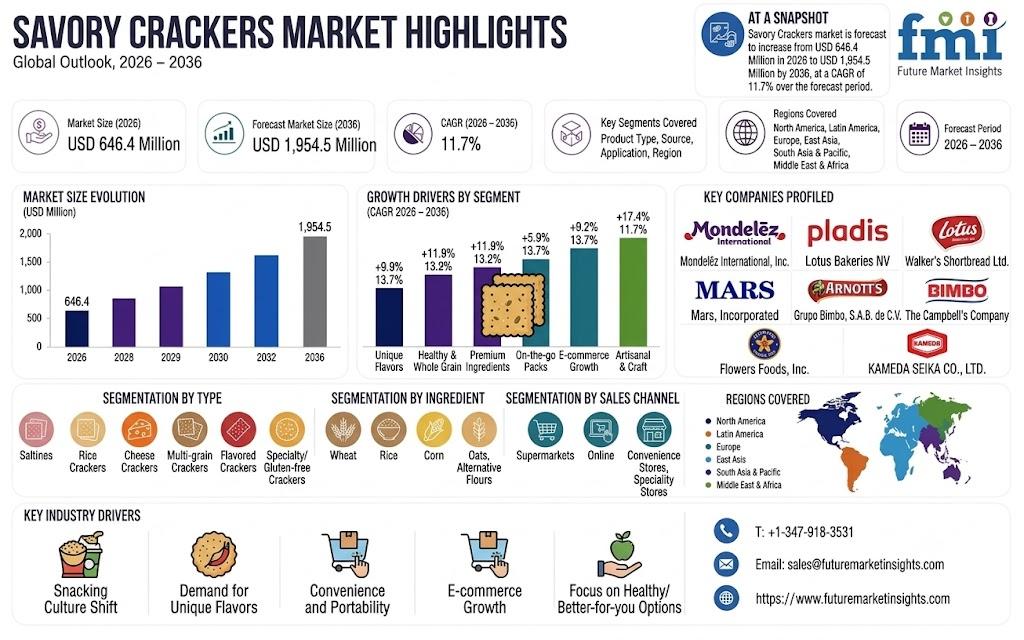
Savory Crackers Market Classic Salted Leads Product Types at 28.0% The global Savory Crackers Market is forecast to increase from USD 646.4 million in 2026 to USD 1,954.5 million by 2036, expanding at an 11.7% CAGR during the 2026–2036 forecast period, according to Future Market Insights. Demand for savory crackers is expanding as frequent snacking, sharing, food pairing, and convenient...