


XLPE Cable Industry Targets $65.99B by 2035

The XLPE cable industry manufactures cross-linked polyethylene insulated power cables that have become the default choice for medium and high voltage transmission and distribution, prized for superior electrical properties, thermal resistance, and durability across demanding environments. According to Market Research Future, the XLPE Cable Industry was estimated at USD 25,416.0 million in 2024 and is projected to reach USD 65,995.8 million by 2035, expanding at a compound annual growth rate of 9.06% during the 2025 to 2035 forecast period. That growth reflects a sector benefiting from renewable energy buildout, energy efficiency imperatives, and infrastructure modernization programs that require advanced cable technologies to connect generation to load centers.
Key Statistics Defining the Industry
The headline figures frame an industry moving from USD 27,719.2 million in 2025 toward USD 65,995.8 million by 2035. Historical data spans 2019 through 2024, with the base year set at 2024 and the forecast period running from 2025 to 2035.
Segment-level data reveals where value concentrates. On application, power distribution holds the largest share, attributed to wide usage in electrical grids and utility applications. The renewable energy application was valued at USD 8,000.0 million in 2024 and is projected to grow to USD 21,000.0 million by 2035, reflecting the global shift toward sustainable energy solutions. Industrial applications, telecommunications, and transportation complete the distribution.
On end use, utilities hold the dominant share with a market valuation of USD 8,000.0 million in 2024, driven by the need for reliable power distribution and transmission systems. Telecommunications is emerging rapidly as a notable segment, driven by increased investments in communication infrastructure, the rapid growth of data centers, and the rollout of 5G technology.
On voltage rating, low voltage cables hold the largest market share with a market size of USD 10,166.4 million in 2024, largely due to extensive application in building infrastructure, residential projects, and various industrial setups. High voltage cables are witnessing significant traction owing to their indispensable role in long-distance energy transmission, particularly in renewable energy projects. On conductor type, copper conductor holds the largest market share due to superior conductivity and reliability, while composite conductor is gaining traction for lightweight and cost-effective solutions.
Regional distribution shows Asia-Pacific as the largest market, projected to reach USD 12,000.0 million by 2025, driven by rapid industrialization and urbanization. North America is projected to reach USD 8,000.0 million by 2025, Europe USD 7,000.0 million, and the Middle East and Africa USD 2,416.0 million.
Industry Trends Reshaping the Landscape
Three structural trends define the industry's evolution. The first is technological advancement. Manufacturers are investing in research and development to create cables with improved insulation properties and resistance to environmental factors, increasing lifespan and reducing maintenance costs. The introduction of smart cables that can monitor their own performance and detect faults is gaining traction. Advances in production techniques, such as improved extrusion processes and enhanced material formulations, have led to more efficient and durable cables.
The second trend is sustainability focus. As industries transition toward renewable energy sources, demand for environmentally friendly cable solutions is increasing. XLPE cables, known for lower environmental impact compared to traditional materials, are becoming a preferred choice for eco-conscious projects.
The third trend is regulatory support. Governments are increasingly implementing standards that promote the use of high-performance materials in electrical installations, encouraging manufacturers to innovate and improve product offerings.
Challenges Facing the Industry
Capital intensity in manufacturing affects the ability of suppliers to scale production rapidly. Raw material price volatility, particularly for copper and aluminum, affects production costs and pricing strategies. Technical complexity in high-voltage cable design requires specialized engineering capability. Competition from alternative insulation materials influences adoption in some lower-voltage segments.
Future Outlook and Technology Adoption
The forward trajectory points toward continued growth supported by renewable energy demand. The renewable energy sector is projected to grow at a compound annual growth rate of over 8% in the coming years, propelling the need for XLPE cables to connect wind and solar farms to the grid. Infrastructure development initiatives, including smart cities and grid modernization, are expected to drive growth of approximately 6% annually over the next decade. Urbanization rates are expected to reach 68% by 2050, necessitating significant investments in electrical infrastructure.
Technological development focuses on expansion into emerging markets with tailored XLPE solutions, development of smart grid technologies integrating XLPE cables, and partnerships with renewable energy firms for specialized cable applications.
Expert Discussion
Analysts contributing to the assessment emphasize that competitive dynamics are shaped by innovation and sustainability. Prysmian Group focuses on innovation and sustainability, investing heavily in research and development to enhance product performance and reduce environmental impact, and announced in November 2025 a significant investment in a new manufacturing facility in Eastern Europe aimed at increasing production capacity. Nexans emphasizes digital transformation, integrating smart technologies into its cable solutions to improve efficiency and reliability, and launched a new range of eco-friendly XLPE cables in October 2025 designed to meet stringent environmental regulations. Southwire Company is actively pursuing regional expansion, and entered into a strategic partnership in September 2025 with a leading renewable energy firm to supply XLPE cables for solar and wind projects.
Experts also highlight that the market structure appears moderately fragmented, with a mix of established players and emerging competitors, fostering competition that drives innovation. Key players include Prysmian Group, Nexans, General Cable, Southwire Company, Sumitomo Electric Industries, LS Cable & System, Furukawa Electric Co., Apar Industries, and Havells India Limited.
Conclusion
The XLPE cable industry reflects a sector with strong growth fundamentals. Current momentum rests on power distribution's dominance and utilities end-use leadership. Emerging opportunities lie in renewable energy applications, smart grid integration, and emerging market expansion. Technological developments in smart cables and eco-friendly formulations are steadily improving performance and sustainability. The long-term outlook anticipates the XLPE Cable Market reaching USD 65,995.8 million by 2035, with growth supported by renewable energy buildout, grid modernization, and continued urbanization worldwide.
Gain valuable insights through comprehensive industry analysis:
US Managed Pressure drilling Market
US Traction Transformer Market
US Air Operated Double Diaphragm Pumps Market
Categorie
Leggi tutto
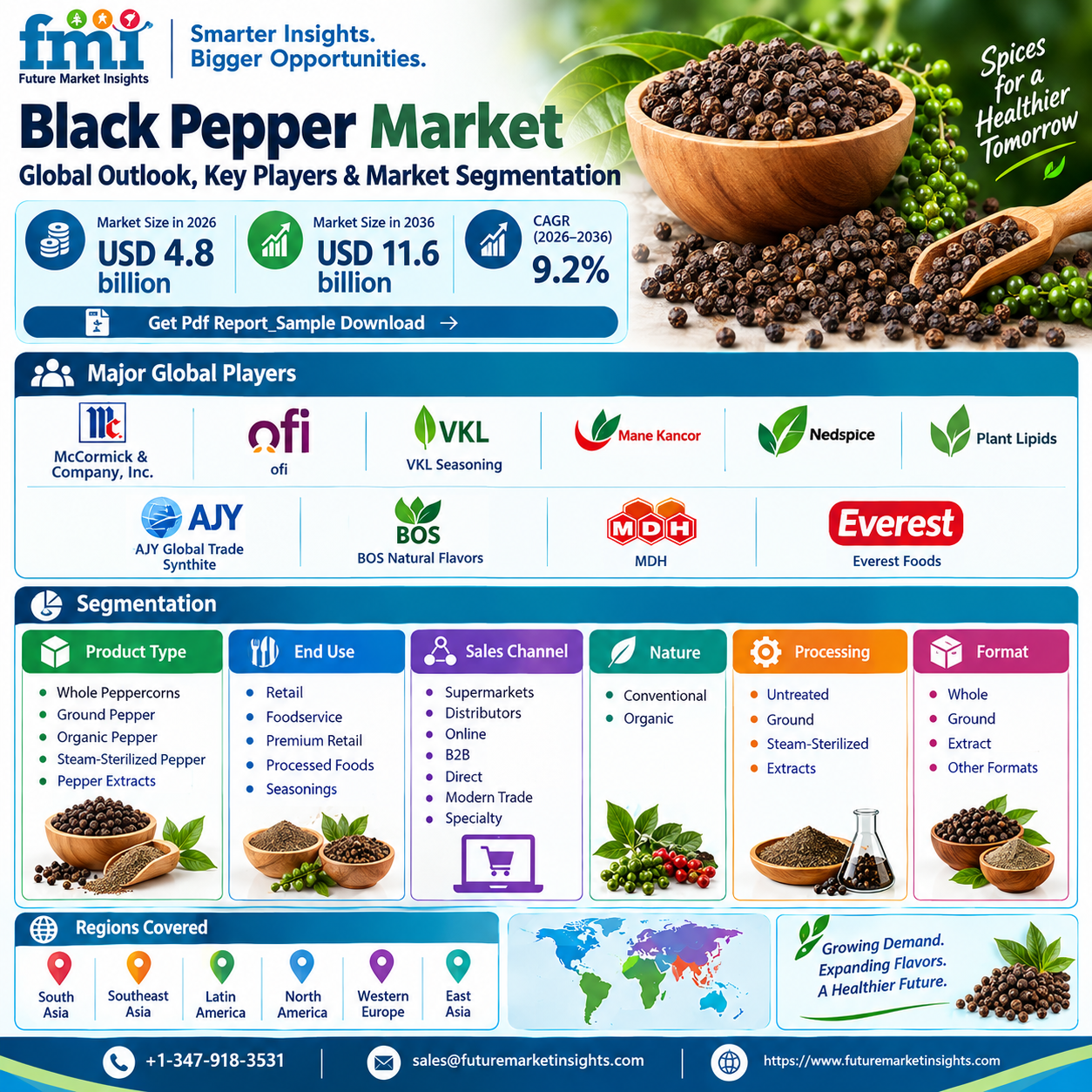
The global black pepper market is projected to reach USD 11.6 billion by 2036, expanding at a 9.2% CAGR between 2026 and 2036. In 2026, the market is estimated at USD 4.8 billion. The opportunity is substantial. But the more important story is how the market is evolving. The next phase of black pepper growth will be about more than volume Black pepper continues to benefit from its role as an...
Healthcare core administration encompasses the systems and processes that support billing, claims processing, member enrollment, provider management, and regulatory compliance. As healthcare grows more complex, organizations are increasing technology spending to modernize these functions. The global market for technology spending on healthcare core administration is expanding rapidly. The...

The precise monitoring and regulation of liquid and gaseous fluids represent a foundational operating requirement across water management facilities, oil and gas distribution channels, chemical refineries, pharmaceutical manufacturing lines, and modern automotive powertrains. Within this rapidly advancing industrial automation and analytical instrumentation landscape, the Flow Sensor Industry...

Osteomyelitis — an infection of the bone — is a serious condition that can lead to chronic pain, disability, and even amputation if not treated promptly. In Italy, as in other developed countries, the condition is most common in patients with diabetes, those recovering from surgery, and the elderly. The country's healthcare system is well equipped to diagnose and treat...
Market OverviewThe eye care surgical sector is growing as aging populations face cataracts, glaucoma, and retinal conditions. Advances in minimally invasive techniques and precision instruments are improving safety and recovery times. The sector is projected to expand through 2030, supported by rising surgical volumes, better access to eye care, and technological progress. Specialists following...