


Topical Pain Relievers Market: The Importance of Consumer Education and Responsible Self-Care
Consumers increasingly use nonprescription healthcare products to manage minor, everyday discomfort. Topical pain relievers are among the options available through pharmacies and retail channels, offering products in several formulations and active-ingredient categories. As product choices expand, clear information about safe use and appropriate selection becomes increasingly important.
The Topical Pain Relievers Market serves consumers seeking products for localized muscle and joint discomfort. Its development is influenced by self-care trends, pharmacy distribution, product innovation, and consumer understanding of topical treatment options.
Growing Interest in Self-Care
Self-care includes everyday practices that help individuals maintain well-being and manage minor health concerns. Topical pain relievers can form part of this approach when used appropriately and according to product directions.
Consumers may choose products based on the affected area, preferred formulation, active ingredient, and application convenience. Pharmacists can help explain differences between products and identify situations where medical advice is more appropriate.
Understanding Active Ingredients
Topical products may contain different types of ingredients, including counterirritants, local anesthetics, and anti-inflammatory medicines. These ingredients do not all work in the same way, and their precautions can differ.
Reading product labels is important. Consumers should follow recommended application amounts, frequency, and duration rather than assuming that more frequent use will provide better relief.
Role of Pharmacies and Digital Information
Community pharmacies are important sources of product information. Pharmacists can explain application instructions, potential interactions, and relevant safety precautions.
Online product pages and educational resources also influence consumer decisions. Accurate descriptions of active ingredients, intended uses, warnings, and storage requirements can support more informed purchases.
Safety and When to Seek Medical Advice
Topical pain relievers may cause skin irritation or other adverse effects, depending on the ingredient and individual sensitivity. Products should not be applied to damaged skin unless specifically directed by a healthcare professional.
Pain that is severe, persistent, associated with significant swelling, or linked to a suspected serious injury should be evaluated by a healthcare professional.
Future Market Direction
Consumer education, transparent labeling, and responsible product innovation are likely to remain important. Companies that combine convenient formulations with clear safety information can strengthen consumer confidence and support sustainable market development.
People Also Ask
1. Why should consumers read topical pain reliever labels?
Labels explain active ingredients, application instructions, warnings, and precautions.
2. When should someone seek medical advice for pain?
Medical advice is appropriate for severe, persistent, worsening, or unexplained pain.
Tags: Topical Pain Relievers Market, Consumer Healthcare, Self-Care, Pharmacy Products, Pain Relief Safety, Topical Analgesics, Healthcare Education
Categorie
Leggi tutto
The fabrication of modern microelectromechanical systems (MEMS), high-power wide-bandgap transistors, RF surface acoustic wave filters, and advanced 2.5D/3D interposers requires specialized metal deposition processing that often falls outside the core capabilities of standard digital CMOS logic fabs. Fabless semiconductor designers, research institutes, and specialized device makers require...

Advances in molecular biology are creating opportunities to study diseases at increasingly detailed levels. Researchers are moving beyond broad tissue-level measurements to investigate how individual cells contribute to biological processes and disease development. Single-cell RNA sequencing is supporting this shift by providing gene-expression information from individual cells, helping...
Market Overview The India Vaccine Technologies Market is increasingly connected with pandemic preparedness and the need to respond quickly to emerging infectious diseases. Recent global health emergencies demonstrated the importance of flexible platforms, scalable manufacturing, rapid clinical research, and reliable distribution systems. The India Vaccine Technologies Market is developing...
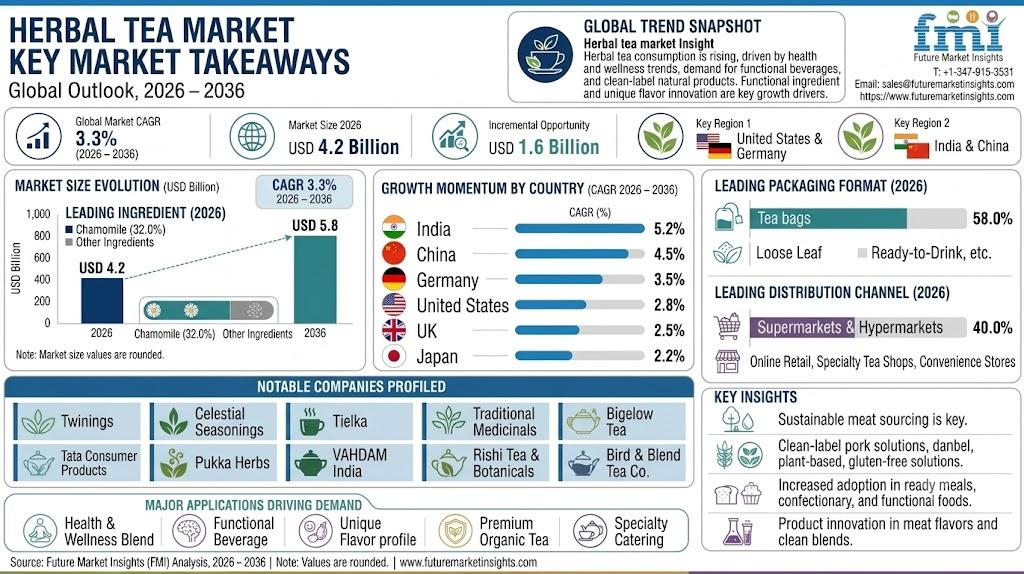
Herbal Tea Market: Chamomile and Tea Bags Lead as Demand for Caffeine-Free Wellness Beverages NEWARK, Del., October 15, 2026 — The global Herbal Tea Market is gaining momentum as consumers increasingly incorporate caffeine-free botanical infusions into daily wellness routines focused on relaxation, digestive comfort, hydration, and stress management. According to the latest market...
Rising clinical recognition of hyper-inflammatory syndromes, expanding genetic screening for familial forms, and rapid commercial adoption of targeted monoclonal antibodies are driving growth across the global Hemophagocytic Lymphohistiocytosis Treatment Market. Hemophagocytic lymphohistiocytosis (HLH) is a severe, life-threatening hyper-inflammatory disorder caused by uncontrolled activation...