


Orthopedic Trauma Devices Market – Intramedullary Nailing Evolution Enhancing Load-Sharing Fixation for Long Bone Fractures
Market Overview
The orthopedic trauma devices market is advancing intramedullary nailing technologies that provide load-sharing fixation for diaphyseal and metaphyseal long bone fractures with minimal soft tissue disruption. Next-generation nails feature enhanced locking options, radiolucent materials, and insertion instruments that reduce operative time and radiation exposure. The Orthopedic Trauma Devices Market is forecast to expand through 2035, driven by nailing system innovation, expanding minimally invasive trauma surgery adoption, growing evidence supporting early weight-bearing with modern nails, and increasing surgeon preference for intramedullary over plate fixation in suitable fracture patterns.
Trauma services are transitioning from open reduction and plating to closed nailing techniques for femoral shaft, tibial shaft, and humeral fractures. Growing adoption of the Orthopedic Trauma Devices reflects the biomechanical advantage, where intramedullary nails share axial load with the bone cortex, promote secondary bone healing through callus formation, and enable earlier weight-bearing compared to load-bearing plate constructs that risk stress shielding and implant failure in high-demand patients.
Current Market Landscape
Cephalomedullary nails integrating proximal femoral fixation for intertrochanteric and subtrochanteric fractures. Tibial nails with multiplanar distal locking options for metaphyseal extension. Humeral nails with proximal locking bolts avoiding rotator cuff violation. Radiolucent carbon-fiber reinforced polymer nails enabling intraoperative imaging without artifact. Targeting jigs reducing fluoroscopy time and radiation exposure to surgical team. Minimally invasive insertion techniques preserving fracture hematoma and biology. Early weight-bearing protocols enabled by modern nail biomechanics. Registry data tracking nailing outcomes across fracture patterns and patient demographics. Global training programs certifying surgeons in advanced nailing techniques. Inventory standardization ensuring nail availability across common long bone indications.
Emerging Trends
Expandable nails eliminating interlocking screws for certain tibial and humeral indications. Bioabsorbable nails under development to avoid hardware removal in select patients. Navigation-guided nail insertion improving alignment and reducing malunion rates. Combination nailing and bone stimulator therapy accelerating union in high-risk fractures. Patient-specific nail designs fabricated via additive manufacturing for complex deformity correction.
Future Outlook
Intramedullary nailing will likely remain first-line for diaphyseal long bone fractures through 2035. Expandable and bioabsorbable options will likely reduce secondary procedures for hardware removal. Navigation integration will likely improve alignment and reduce revision rates. Market growth will likely accelerate as minimally invasive trauma surgery adoption expands globally.
Conclusion
Orthopedic trauma devices benefit significantly from intramedullary nailing evolution, enabling load-sharing fixation that promotes biological healing and early weight-bearing in long bone fractures. Continued innovation in expandable, bioabsorbable, and navigation-guided systems will likely expand nailing indications and improve patient outcomes.
FAQ
Q1: What biomechanical advantages do intramedullary nails provide over plates?
A: Load-sharing construct distributes axial force between nail and bone cortex. Promotes secondary bone healing through callus formation rather than primary contact healing. Enables earlier weight-bearing without risk of implant failure from cyclic loading. Reduces stress shielding compared to rigid load-bearing plate constructs.
Q2: Which fracture patterns are best treated with intramedullary nailing?
A: Femoral shaft fractures with minimal articular extension benefit from cephalomedullary or straight nails. Tibial shaft fractures with metaphyseal extension utilize multiplanar distal locking options. Humeral shaft fractures avoid rotator cuff violation with proximal locking bolt designs. Selected forearm fractures in adults utilize flexible or rigid nailing techniques.
#IntramedullaryNailing #LongBoneFractures #MinimallyInvasive
Categorii
Citeste mai mult
Percutaneous coronary intervention has always been effective, but it has not always been risk-free. Early procedures had higher rates of complications, including restenosis and stent thrombosis. Over the decades, technology and technique have improved dramatically, making PCI one of the safest and most effective cardiac procedures available. Here is why. Better stents have made a major...

Systemic lupus erythematosus is a chronic autoimmune disease that can affect nearly any organ in the body. It causes inflammation, pain, and organ damage, and it disproportionately affects women. In the United States, over 200,000 people live with lupus. Treatment has advanced significantly, and the market for lupus therapies is growing as new drugs emerge. Lupus symptoms include fatigue, joint...
The future of the China Companion Diagnostics Oncology Market will be defined by continued innovation, personalized medicine, and expanding applications across therapeutic monitoring, patient stratification, and predictive testing. The market is projected to grow from USD 368.05 million in 2025 to USD 750.12 million by 2035, registering a CAGR of 7.38% during the forecast period. This...
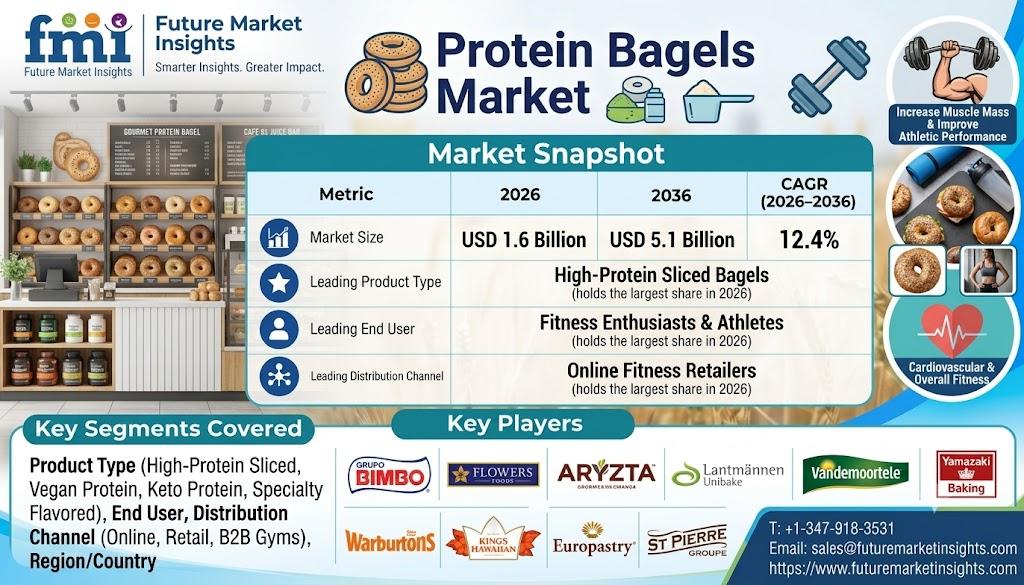
Protein Bagels Market as Protein-Enriched Bakery Products Gain Momentum The global Protein Bagels Market is projected to grow from USD 1.6 billion in 2026 to USD 5.1 billion by 2036, advancing at a 12.4% CAGR during the forecast period, according to the latest research from Future Market Insights (FMI). The market is benefiting from increasing consumer interest in higher-protein foods that can...
Market OverviewHospital-grade breast pumps are becoming a major growth segment within the breast pumps market as neonatal intensive care units, donor milk banks, and home-based maternal care programs expand. These multi-user, closed-system pumps are designed for frequent, high-cycle use and strict hygiene requirements. The Breast Pumps Market is projected to grow from USD 3.87 billion in 2025...