


Non-Infectious Uveitis Market – Immunosuppressive Agents Serving as Steroid-Sparing Maintenance Therapy
Market Overview
Immunosuppressive agents are serving as steroid-sparing maintenance therapy for non-infectious uveitis patients requiring long-term inflammation control without corticosteroid complications like cataracts, glaucoma, and systemic metabolic effects. Methotrexate, mycophenolate mofetil, azathioprine, and cyclosporine are established as foundational therapies that enable corticosteroid tapering while maintaining disease quiescence in chronic uveitis. The Non-Infectious Uveitis Market demonstrates sustained immunosuppressive agent utilization, driven by chronic uveitis prevalence requiring prolonged therapy, treatment guideline recommendations for early immunosuppressive initiation to minimize steroid exposure, established safety profiles from decades of rheumatology and transplant use, cost-effectiveness versus biologic therapies, and patient preference for oral or infrequent dosing versus frequent injections or infusions.
Current Market Landscape
Methotrexate weekly dosing as first-line immunosuppressive for non-infectious uveitis across age groups. Mycophenolate mofetil twice-daily dosing offering alternative mechanism with favorable tolerability profile. Azathioprine daily dosing utilized for patients intolerant to methotrexate or mycophenolate. Cyclosporine monitoring with blood levels to optimize dosing and minimize nephrotoxicity risk. Combination immunosuppressive therapy pairing agents with complementary mechanisms for refractory cases. Comprehensive immunosuppressive portfolio. Uveitis specialists initiating immunosuppressives early in treatment courses to enable rapid corticosteroid tapering. Monitoring protocols tracking complete blood counts, liver enzymes, and renal function to detect immunosuppressive toxicity early. Patient education emphasizing immunosuppressive benefits of steroid-sparing and long-term disease control. Folic acid supplementation protocols reducing methotrexate side effects while maintaining efficacy. Pregnancy planning counseling addressing immunosuppressive teratogenicity risks and alternative therapy options. Clinical studies comparing immunosuppressive efficacy and safety across different uveitis etiologies and patient populations. Treatment optimization.
Emerging Trends
Targeted synthetic immunosuppressives like JAK inhibitors offering oral alternatives with specific mechanism of action. Therapeutic drug monitoring utilizing metabolite levels to optimize immunosuppressive dosing individually. Pharmacogenomic testing predicting immunosuppressive metabolism and toxicity risk based on patient genetic profiles. Extended-release formulations reducing dosing frequency for improved adherence and convenience. Biosimilar immunosuppressives reducing costs for expensive agents like cyclosporine and mycophenolate. Precision immunosuppression advancement.
Future Outlook
Targeted synthetic immunosuppressives will likely expand oral therapy options with specific mechanisms and favorable safety profiles. Therapeutic drug monitoring will likely become standard for optimizing immunosuppressive dosing based on individual patient metabolism. Pharmacogenomic testing will likely guide immunosuppressive selection to minimize toxicity risk and maximize efficacy. Market utilization will likely remain strong through 2030 as immunosuppressives serve as foundational therapy for chronic uveitis.
Conclusion
Immunosuppressive agents substantially benefit the non-infectious uveitis market by enabling steroid-sparing maintenance therapy that controls chronic inflammation while avoiding corticosteroid complications, serving as foundational treatment upon which biologic escalation can be built for refractory cases. Targeted synthetics and personalized dosing will likely enhance immunosuppressive value further.
FAQ
Q1: What immunosuppressive agents treat non-infectious uveitis?
A: Methotrexate weekly dosing serves as first-line immunosuppressive for non-infectious uveitis across age groups. Mycophenolate mofetil twice-daily dosing offers alternative mechanism with favorable tolerability profile. Azathioprine daily dosing utilized for patients intolerant to methotrexate or mycophenolate alternatives. Cyclosporine monitoring with blood levels optimizes dosing and minimizes nephrotoxicity risk. Combination immunosuppressive therapy pairs agents with complementary mechanisms for refractory cases. Treatment diversity.
Q2: What trends shape immunosuppressive uveitis therapy evolution?
A: Targeted synthetic immunosuppressives like JAK inhibitors offer oral alternatives with specific mechanism of action. Therapeutic drug monitoring utilizes metabolite levels to optimize immunosuppressive dosing individually. Pharmacogenomic testing predicts immunosuppressive metabolism and toxicity risk based on patient genetic profiles. Extended-release formulations reduce dosing frequency for improved adherence and convenience. Biosimilar immunosuppressives reduce costs for expensive agents like cyclosporine and mycophenolate. Innovation direction.
#ImmunosuppressiveAgents #SteroidSparing #ChronicUveitis
Categorie
Leggi tutto
Market Overview Pulmonology integration and respiratory care coordination represent essential capabilities advancing spirometry through pulmonology specialist networks, multidisciplinary coordination, and comprehensive programs enabling systematic equipment access and optimized respiratory outcomes. The Spirometer Market transformation toward integration substantially improves outcomes....

Technological breakthroughs in intraoral scanning, 3D printing, and AI-powered design are fundamentally transforming the UK Dental CAD/CAM Market, enabling dental professionals to deliver faster, more precise, and more patient-friendly care. Intraoral scanners now dominate chairside impressions in the UK private sector, with penetration exceeding 65% in private practices and rising in NHS...
The rising incidence of genetic disorders and the growing emphasis on early disease detection have propelled substantial expansion in the reproductive health diagnostics domain. According to detailed industry evaluation of the Prenatal Testing and Newborn Screening Market, non-invasive prenatal testing, invasive prenatal testing, and newborn screening tests remain among the most...
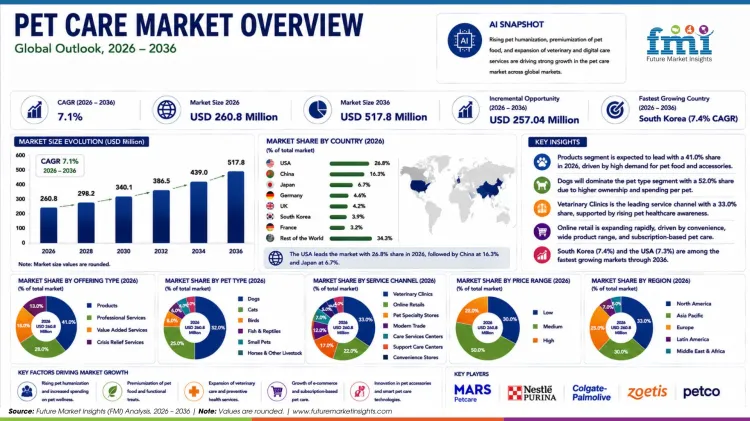
Pet Care Market Dogs Lead Pet Type Segment at 52.0% The global pet care market is forecast to increase from USD 260.8 billion in 2026 to USD 517.8 billion by 2036, expanding at a 7.1% CAGR during the 2026-2036 forecast period, according to Future Market Insights. The market was valued at USD 243.5 billion in 2025. Growth is being supported by continued pet ownership, increasing...
Market OverviewThe South America dry age-related macular degeneration market is poised for significant growth, driven by the increasing aging population, rising prevalence of AMD, and technological advancements in diagnostics and treatment. Dry AMD is a leading cause of vision loss among older adults, and South America's aging population is driving demand for effective treatments. The market...