


Global Industrial Fluid Dynamics Innovations Driving Modern Flow Sensor Technology Across Critical Process Infrastructure

The precise monitoring and regulation of liquid and gaseous fluids represent a foundational operating requirement across water management facilities, oil and gas distribution channels, chemical refineries, pharmaceutical manufacturing lines, and modern automotive powertrains. Within this rapidly advancing industrial automation and analytical instrumentation landscape, the Flow Sensor Industry serves as a vital infrastructure pillar enabling real-time volumetric and mass flow measurement, leak detection, and closed-loop process optimization. Historically, industrial facilities relied heavily on mechanical flow meters—such as turbine wheels, differential pressure orifice plates, and positive displacement meters—that featured moving parts susceptible to physical wear, mechanical drift, and pressure drops across the pipeline. Modern solid-state and non-intrusive flow measurement architectures overcome these mechanical constraints by deploying acoustic transit-time transducers, electromagnetic Faraday induction coils, Coriolis vibrating tubes, and microelectromechanical thermal sensors. By delivering continuous, drift-free telemetry across corrosive slurries, ultra-pure chemicals, and pressurized gases, modern flow sensors enable facility operators to stabilize reaction yields, minimize fluid losses, and maintain strict regulatory compliance across complex distribution systems.
Municipal clean water treatment plants, regional wastewater processing facilities, and smart utility distribution networks represent primary public infrastructure domains accelerating the procurement of electromagnetic and acoustic flow instrumentation. Modern water utilities are confronted with aging urban pipe networks that suffer from significant non-revenue water losses caused by subterranean pipeline bursts, unauthorized usage, and inaccurate analog metering. To mitigate water losses and optimize network pressures, municipal utility boards are deploying clamp-on ultrasonic flow meters and full-bore magnetic flow meters integrated with long-range low-power wireless transmitters at critical network junctions. Because magnetic meters present an unobstructed open-bore pipeline profile with no moving components, they measure raw sewage and abrasive wastewater slurries without suffering from particulate clogging or causing head-loss penalties. This automated fluid tracking enables utility operators to locate underground pipeline leaks rapidly, balance pumping energy expenditures, and ensure equitable potable water access across growing metropolitan zones.
The biopharmaceutical, food and beverage, and fine chemical processing industries provide an equally vital commercial driver for high-purity and mass-flow measurement hardware. Modern biopharmaceutical manufacturing facilities operating single-use bioreactors and chromatographic purification skids require sanitary flow sensors capable of measuring micro-liter fluid additions with extreme precision while maintaining sterile fluid isolation. Coriolis mass flow meters and single-use clamp-on ultrasonic sensors meet these stringent clinical demands by measuring true fluid mass, liquid density, and fluid temperature simultaneously without coming into direct physical contact with the active therapeutic solution. Furthermore, automated clean-in-place and steam-in-place sterilization procedures across dairy and beverage bottling plants demand sanitary stainless-steel sensors that endure aggressive chemical flushes and high thermal cycles without losing factory calibration, ensuring product consistency and adhering strictly to international food hygiene standards.
Long-term expansion across the fluid instrumentation landscape rests on continuous advancements in low-power digital signal processors, advanced multi-frequency acoustic beamforming, and universal digital industrial bus interfaces. Instrument engineers are integrating edge-computing microcontrollers directly into sensor transmitter heads, enabling continuous self-validation algorithms that monitor acoustic signal attenuation, electrode coating build-up, and vibrating tube resonance shifts in real time. Concurrently, instrumentation fabricators are embedding digital industrial protocols—such as IO-Link, HART, Foundation Fieldbus, and wireless industrial mesh standards—into sensor transmitters to stream multi-variable telemetry and predictive maintenance alerts directly into centralized supervisory execution systems. By uniting solid-state fluid physics, automated diagnostic firmware, and open industrial networking standards, modern flow sensor platforms establish a dependable, maintenance-free foundation for industrial fluid management.
Top Trending Reports :
South Korea Super Capacitor Market
North America Super Capacitor Market
Catégories
Lire la suite
Market Overview The blood pressure monitoring device market is being reshaped by remote patient monitoring trends that extend hypertension management beyond clinical walls. Connected monitors now allow patients to track readings at home while sharing real-time data with care teams for proactive intervention. The market is projected to grow through 2030, driven by rising global hypertension...

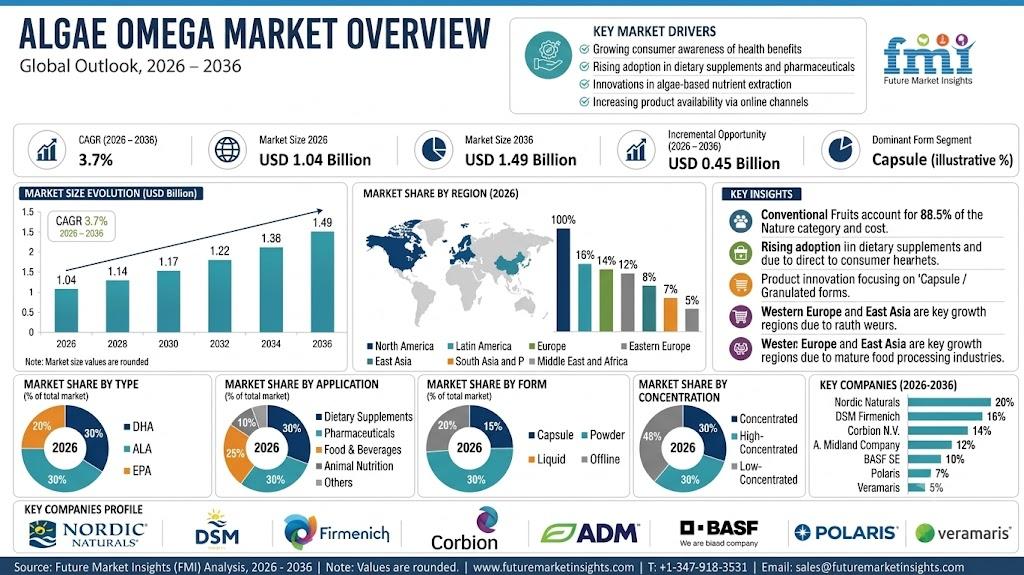
The global algae omega market is estimated at USD 1.04 billion in 2026 and is projected to reach USD 1.49 billion by 2036, expanding at a 3.7% CAGR during the 2026-2036 forecast period, according to Future Market Insights. Growth is being supported by increasing adoption of plant-based omega-3 ingredients, rising demand for high-purity DHA in prenatal and infant nutrition, and expanding...
Market Overview The hydrogen inhalation unit market is gaining momentum as molecular hydrogen therapy attracts interest from both wellness consumers and clinical researchers exploring its antioxidant potential. These devices generate hydrogen gas for inhalation, purportedly supporting cellular protection against oxidative stress. The Hydrogen Inhalation Unit Market is projected to expand...
The convergence of artificial intelligence, real-world data analytics, and remote patient monitoring is transforming execution strategies across clinical trial operations. Detailed analysis within the Contract Research Organization Market report reveals that AI-driven data management platforms enable CROs to monitor continuous trial data streams, detect protocol deviations automatically, and...
The Cetrorelix Acetate for Injection Market is growing as demand increases for assisted reproductive technologies, fertility treatment, and hormone-related therapies. Cetrorelix acetate is a gonadotropin-releasing hormone antagonist used in controlled ovarian stimulation protocols. According to Wise Guy Reports, the market was valued at USD 799.2 million in 2024 and is projected to grow from...