


Fire Resistance Cable Market: The Hidden Backbone of Modern Building Safety

According to Market Research Future, the fire resistance cable market is experiencing unprecedented growth as building safety regulations tighten across the globe. In an era where infrastructure resilience has become paramount, the cables running silently through our walls, tunnels, and high-rises have emerged as critical lifelines during emergencies. These specialized cables are engineered to maintain circuit integrity under extreme heat conditions, ensuring that life-saving systems continue functioning when they are needed most.
Understanding the Fundamentals
Fire resistance cables are not merely ordinary electrical conduits wrapped in protective sheathing. They represent a sophisticated category of engineered products designed to withstand temperatures exceeding 800°C for extended periods while maintaining electrical continuity. The technology behind these cables involves advanced insulation materials, typically utilizing mineral compounds such as magnesium oxide or ceramic-forming polymers that create a protective barrier when exposed to intense heat.
The distinction between fire-resistant and fire-retardant cables often confuses industry newcomers. While fire-retardant cables slow flame propagation, fire-resistant varieties guarantee circuit integrity during a fire event. This fundamental difference determines their application across critical infrastructure where failure could mean catastrophic consequences.
Regulatory Landscape Shaping Demand
Building codes worldwide have undergone significant transformation in recent years, mandating fire-resistant cabling in increasingly specific applications. The International Building Code, European standards under the Construction Products Regulation, and various national frameworks now require these cables in emergency lighting systems, fire alarm circuits, smoke extraction equipment, and critical communication networks.
The tragic high-rise fires of recent decades have catalyzed much of this regulatory evolution. Authorities now recognize that evacuation success depends not just on detection systems but on their continued operation throughout an emergency. This recognition has expanded the addressable market significantly, moving fire-resistant cables from niche specialty products to mainstream construction requirements.
Key Application Segments Driving Growth
High-Rise Construction
Vertical cities continue rising across Asia-Pacific, the Middle East, and North America, each requiring comprehensive fire safety infrastructure. Modern skyscrapers incorporate thousands of meters of fire-resistant cabling connecting sprinkler controls, emergency elevators, pressurization systems, and public address networks. The taller the building, the more critical these circuits become, as evacuation times extend and reliance on mechanical systems increases.
Transportation Infrastructure
Metro systems, airports, and road tunnels represent some of the most demanding environments for fire-resistant cables. Confined underground spaces amplify fire risks while complicating evacuation. Engineers specify cables capable of maintaining operation for extended durations, allowing safe passenger egress before systems potentially fail.
Industrial Facilities
Petrochemical plants, power generation stations, and manufacturing complexes present unique challenges where fire risks coexist with explosive atmospheres. Fire-resistant cables in these environments must meet additional certification requirements for hazardous area classification while delivering the same circuit integrity guarantees.
Technological Innovations Reshaping the Industry
Manufacturers continue pushing the boundaries of what fire-resistant cables can achieve. Recent developments include:
Enhanced Temperature Ratings: New formulations now maintain circuit integrity at temperatures approaching 1,100°C, expanding application possibilities in extreme industrial environments.
Improved Flexibility: Traditional fire-resistant cables were notoriously stiff and difficult to install. Modern designs incorporate flexible mineral insulation that simplifies routing through complex building geometries.
Reduced Diameter: Space constraints in retrofit applications have driven development of thinner cables delivering equivalent performance, making upgrades feasible in existing structures.
Smart Integration: Emerging products incorporate sensors capable of reporting cable health status, enabling predictive maintenance and early identification of degradation before failure occurs.
Regional Market Dynamics
Europe Leading Standards Adoption
European markets have embraced fire-resistant cabling most comprehensively, driven by stringent harmonized standards and lessons learned from historical incidents. The continent's aging infrastructure requires extensive retrofitting, creating sustained demand across renovation and new construction segments.
Asia-Pacific Experiencing Rapid Expansion
Urbanization across China, India, and Southeast Asia has generated massive construction activity, with fire safety requirements increasingly aligned with international best practices. Government initiatives mandating safety upgrades in public buildings have accelerated adoption rates.
North America Focusing on Code Compliance
North American adoption varies significantly by jurisdiction, with some regions implementing aggressive requirements while others maintain minimum standards. The trend toward uniformity is gradually eliminating regional disparities, creating more predictable market conditions.
Challenges Constraining Growth
Despite favorable regulatory tailwinds, several factors limit market expansion:
Cost Premium: Fire-resistant cables typically cost two to four times more than standard alternatives, creating budget pressure on project developers. Value engineering exercises sometimes target these products for substitution, compromising safety outcomes.
Installation Complexity: Specialized termination procedures and handling requirements demand trained personnel, adding labor costs and extending project timelines.
Verification Difficulties: Confirming that installed cables meet specified performance standards requires specialized testing equipment and expertise that many inspection teams lack.
Supply Chain Concentration: Production capacity remains concentrated among a limited number of manufacturers, creating vulnerability to disruptions and limiting competitive pricing pressure.
Future Outlook and Opportunities
The trajectory for fire-resistant cable demand appears strongly positive across multiple time horizons. Several factors support this optimistic assessment:
Retrofit Market Expansion: Aging building stock across developed economies requires safety system upgrades, opening substantial retrofit opportunities beyond new construction.
Electric Vehicle Infrastructure: Charging stations and battery storage facilities require fire-resistant cabling capable of containing thermal runaway events, creating an entirely new application category.
Data Center Protection: Mission-critical computing facilities demand continuous operation during emergencies, driving specification of fire-resistant cables throughout their power and communication infrastructure.
Renewable Energy Integration: Solar farms, wind installations, and grid-scale battery systems all require fire-resistant connections to ensure safe operation and emergency shutdown capability.
Conclusion
The fire resistance cable market stands at an inflection point, transitioning from a compliance-driven necessity to a recognized cornerstone of resilient infrastructure design. As climate events intensify, urbanization accelerates, and safety expectations rise, these specialized products will play an increasingly central role in protecting lives and assets. Manufacturers, specifiers, and installers who embrace this evolution will find substantial opportunities in the years ahead, while those clinging to legacy approaches risk obsolescence in a rapidly maturing market.
Gain valuable insights through comprehensive industry analysis:
US Distributed Control System Industry
US Wave and Tidal Energy Industry
US Solar Control Glass Industry
US Reciprocating Compressor Industry
US Submarine Power Cable Industry
Categories
Read More
The report titled ‘ADC Contract Manufacturing Market(7th Edition) Forecast 2026 to 2035’ delivers a structured overview of how the industry has progressed over the years, along with expectations for future movement till 2035. This report evaluates changes in the market size and highlights important developments within the industry. It offers clarity on regional patterns, key...

The Benign Prostatic Hyperplasia Testing Market is developing as healthcare systems respond to the diagnostic needs associated with benign prostatic hyperplasia, a common condition involving enlargement of the prostate. Accurate evaluation can help clinicians assess urinary symptoms, distinguish BPH from other conditions, and determine appropriate management pathways. The Benign Prostatic...

The safe storage of compressed natural gas in vehicles is being advanced by compressed natural gas tanks that meet stringent safety requirements while providing reliable fuel storage. Findings from Market Research Future indicate that as natural gas vehicle adoption increases, tank technology continues to evolve. Report Key Statistics Market Research Future's detailed analysis reveals that...

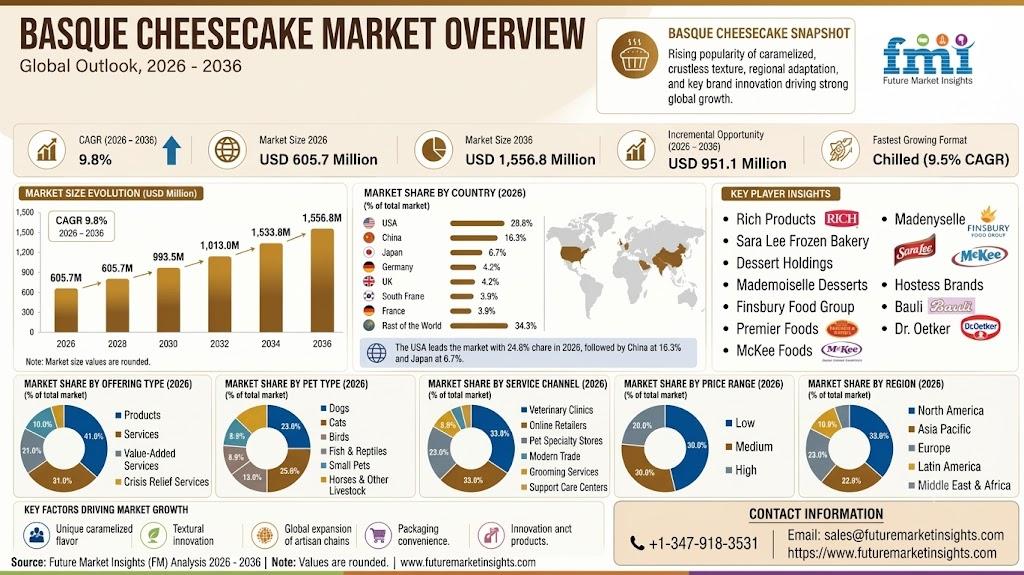
Basque Cheesecake Market to Reach USD 1.56 Billion by 2036 at 9.9% CAGR The global Basque Cheesecake Market is forecast to increase from USD 605.7 million in 2026 to USD 1,556.8 million by 2036, expanding at a 9.9% CAGR during the 2026-2036 forecast period, according to Future Market Insights. The market stood at USD 551.1 million in 2025. Growth is being supported by rising demand for premium...
Market Overview The epistaxis market includes a focus on posterior epistaxis, which is less common but more severe than anterior epistaxis. Posterior epistaxis often requires hospitalization and specialized treatment. The market is projected to grow through 2030, driven by aging population and advances in treatment. ENT departments and interventional radiology are increasingly managing...