


Artificial Intelligence Edge Processing and Hybrid Motion Architectures Reshaping Modern Industrial Controls
Modern industrial motion control platforms are undergoing an engineering evolution, shifting from rigid hardware-bound controllers toward intelligent, software-defined computing engines that leverage the latest GMC based motion controller market trends to optimize machine dynamics, predict mechanical degradation, and simplify commissioning. Automation engineers face increasingly complex multi-axis motion challenges: high-speed packaging machinery and collaborative robots must operate at maximum acceleration rates while avoiding structural mechanical resonances that cause machine vibrations and positioning errors. Traditional motion controllers relied on static tuning parameters that struggled to maintain accuracy when payload masses changed dynamically during operation. Today's GMC platforms deploy hybrid DSP-FPGA architectures, real-time edge-AI adaptive filtering, and cloud-connected digital twin environments, transforming industrial motion control into a self-optimizing mechatronic discipline.
A defining technological development in the sector is the deployment of hybrid controller architectures combining multi-core Digital Signal Processors (DSPs) with high-density Field-Programmable Gate Arrays (FPGAs). In a modern hybrid GMC system, the FPGA handles deterministic, time-critical low-level hardware tasks—including high-speed encoder pulse counting, digital pulse-width modulation (PWM) switching, and sub-microsecond fieldbus frame processing. The multi-core DSP or high-performance ARM processor executes complex high-level kinematic math, multi-axis path planning, and trajectory generation algorithms. This division of computational labor ensures that position control loops run at frequencies exceeding 8 kHz to 16 kHz without computational jitter, providing responsive motor control even during rapid multi-axis directional reversals.
+-----------------------------------------------------------------------------------------+
|                  ADVANCED HYBRID GMC-BASED MOTION CONTROLLER ARCHITECTURE               |
+---------------------+-------------------------------------------------------------------+
| SUPERVISORY LAYER   | Cloud SCADA / MES Link | OPC UA over TSN | Web HMI Interface      |
+---------------------+-------------------------------------------------------------------+
| INTELLIGENCE TIER   | Edge-AI Predictive Maintenance | Adaptive Resonance Notch Filters|
+---------------------+-------------------------------------------------------------------+
| KINEMATIC KERNEL    | Multi-Axis Trajectory Engine | Electronic Cams | 3D Interpolation |
+---------------------+-------------------------------------------------------------------+
| HARDWARE ACCEL TIER | Hybrid DSP + FPGA Fabric | Deterministic Sub-µs Loop Closures     |
+---------------------+-------------------------------------------------------------------+
| PHYSICAL FIELDBUS   | EtherCAT / Profinet IRT / Ethernet/IP | Safe Torque Off (STO) Bus |
+-----------------------------------------------------------------------------------------+
Another major operational trend is the integration of edge-based artificial intelligence for real-time resonance suppression and predictive asset health monitoring. Modern GMC controllers incorporate adaptive notch filtering algorithms that analyze motor torque ripple and frequency spectrums continuously. If a mechanical axis experiences structural vibration due to changing payload weights, the controller adjusts its internal digital notch filters dynamically, dampening resonant frequencies in milliseconds without human intervention. Furthermore, onboard machine learning models compare real-time tracking errors and motor current draws against baseline baseline profiles, identifying mechanical issues—such as ball-screw wear, lack of lubrication, or motor shaft misalignment—weeks before unexpected failure occurs, enabling scheduled predictive maintenance.
Software-defined motion platforms running on Industrial PCs (IPCs) represent an additional technological milestone for the motion control sector. Historically, motion controllers were proprietary closed-box hardware units. Modern software-based GMC platforms execute deterministic real-time motion control kernels directly on multi-core x86 processors running alongside real-time operating systems (RTOS) like Linux Xenomai or Windows Real-Time. This software consolidation allows machine builders to execute motion control, machine vision inspection, and HMI display processing on a single industrial PC, eliminating external cabling, reducing hardware costs, and providing high data-sharing bandwidth between vision systems and motion axes. By uniting hybrid DSP-FPGA hardware, adaptive AI resonance control, and software-defined IPC architectures, modern GMC platforms are establishing high performance and flexibility standards across industrial automation.
Top Trending Reports :
Categorie
Leggi tutto
The Androgen Receptor AR Inhibitor Market is experiencing significant growth, driven by the rising prevalence of hormone-dependent cancers, ongoing advancements in cancer therapies, and the growing demand for innovative treatment options. According to detailed industry evaluation, the market is characterized by sharp innovations, strategic collaborations, and growing demand for...

Gummies: A Complete Guide to Flavours, Types and Benefits Sweet, colourful, and enjoyable, gummies have become one of the most popular types of confectionery products around the world. Their soft texture, creative shapes, and wide range of flavours make them a favourite choice for people looking for a fun sweet treat. From fruit-inspired flavours to sour varieties, gummies are available in many...

The global Erythromelalgia Treatment market is expanding as pharmaceutical companies, hospitals, and specialty clinics invest in advanced therapeutic solutions to address the rising incidence of this rare vascular disorder and improve patient quality of life. The market was valued at USD 129.86 billion in 2023 and is projected to reach USD 341.4 billion by 2032, growing at a CAGR of 11.34%. The...
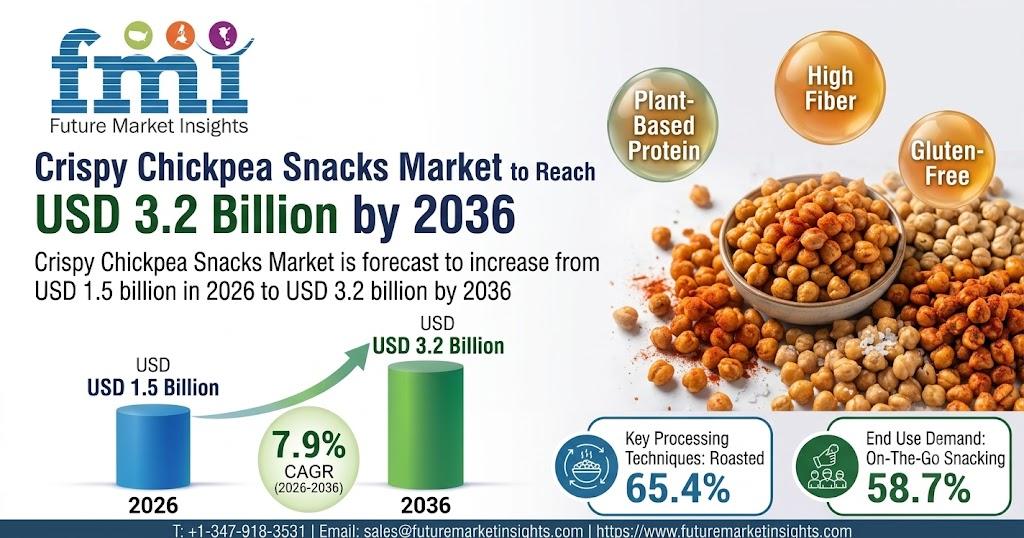
Crispy Chickpea Snacks Market USA Leads Country Growth at 9.2%, Türkiye Follows at 6.6% The global crispy chickpea snacks market is forecast to increase from USD 1.5 billion in 2026 to USD 3.2 billion by 2036, expanding at a 7.9% CAGR during the 2026-2036 forecast period, according to Future Market Insights. The market stood at USD 1.4 billion in 2025. Growth is being supported by the...
Market Overview Beyond cancer, inflammatory bowel disease and diverticular disease are emerging as significant drivers of ostomy creation in South Korea. Ulcerative colitis and Crohn's disease, increasingly diagnosed among younger Koreans, frequently require temporary or permanent stoma construction during disease complications, adding long-duration ostomates to the patient base....