


Digital Certificate Management Software Market Secures Enterprise Identity And Encryption Infrastructure

Digital certificate management software encompasses the lifecycle management platforms, automation tools, and policy enforcement engines that enable organizations to discover, issue, deploy, monitor, renew, and revoke the X.509 digital certificates and cryptographic keys that underpin the identity authentication, data encryption, and secure communications infrastructure of modern enterprise IT environments. The Digital Certificate Management Software Market is experiencing accelerating growth as the exponential proliferation of digital certificates across cloud infrastructure, Internet of Things deployments, containerized microservices, and zero-trust security architectures has transformed certificate management from a manageable administrative task into a mission-critical operational challenge that directly impacts the security posture, regulatory compliance, and service availability of the entire organization. A typical large enterprise may now manage hundreds of thousands to millions of active digital certificates issued by multiple internal and external certificate authorities, each with its own expiration date, key usage constraints, and trust chain dependencies, creating an extraordinarily complex management environment where the failure to renew a single critical certificate before its expiration can trigger cascading service outages affecting thousands of users and millions of dollars in revenue, as dramatically demonstrated by several high-profile certificate expiration incidents at major technology companies and financial institutions in recent years.
The growth drivers propelling the digital certificate management software market are rooted in the fundamental expansion of the cryptographic trust infrastructure that secures every layer of the modern digital economy and the escalating consequences of certificate management failures in an increasingly interconnected and regulated business environment. The most powerful driver is the massive proliferation of TLS/SSL certificates required to encrypt web traffic, API communications, and microservice interactions across hybrid cloud environments, with the transition to shorter certificate validity periods mandated by major browser vendors and certificate authorities, reducing the standard certificate lifespan from two years to 90 days in many cases and dramatically increasing the renewal frequency and automation requirements for enterprise certificate management teams. The zero-trust security architecture movement represents another major growth driver, as organizations implementing zero-trust frameworks require digital certificates to authenticate every user, device, application, and workload before granting access to network resources, multiplying the number of certificates in circulation and elevating the importance of automated certificate lifecycle management to ensure that expired or compromised certificates do not create security vulnerabilities or access disruptions. The IoT and edge computing dimension is increasingly significant, as the projected deployment of tens of billions of connected devices, each requiring a unique device identity certificate for mutual authentication and encrypted communication, creates a certificate management challenge of unprecedented scale that cannot be addressed through manual processes and requires purpose-built automation platforms capable of provisioning, rotating, and revoking certificates across globally distributed device fleets.
The technical architecture of modern digital certificate management platforms reflects the extraordinary scale, automation, and security requirements of managing millions of cryptographic credentials across heterogeneous enterprise environments spanning on-premises data centers, public cloud platforms, container orchestration clusters, and edge computing nodes. The discovery and inventory layer employs network scanning, log analysis, and API integration capabilities to continuously discover all certificates deployed across the organization's infrastructure, including certificates stored in hardware security modules, cloud key management services, web server configurations, load balancers, application keystores, and device firmware, creating a comprehensive real-time inventory that identifies certificates approaching expiration, certificates using deprecated cryptographic algorithms, and certificates issued by untrusted or rogue certificate authorities. The issuance and provisioning layer integrates with multiple public and private certificate authorities through standardized protocols such as ACME, SCEP, EST, and CMP to automate the certificate request, validation, issuance, and deployment workflow, eliminating the manual processes that are the primary source of certificate management errors and delays. The monitoring and alerting engine provides real-time visibility into certificate expiration timelines, revocation status, and chain-of-trust integrity, with configurable alert thresholds that notify responsible teams well in advance of impending expirations and automated escalation workflows that ensure critical certificates are renewed before they expire. The policy enforcement module enables organizations to define and enforce cryptographic standards governing key length, algorithm selection, certificate validity periods, and certificate authority trust hierarchies, automatically rejecting or flagging certificates that do not comply with the organization's security policies.
The geographic and competitive landscape of the digital certificate management software market is shaped by the global distribution of enterprise IT infrastructure, the varying regulatory requirements for cryptographic key management, and the concentration of cybersecurity investment in major technology markets. North America represents the largest market, driven by the massive concentration of cloud-native enterprises, financial institutions, and technology companies in the United States, where the regulatory frameworks governing data protection and cybersecurity, including the SEC's cyber disclosure rules and the CISA zero-trust maturity model, are creating strong compliance-driven demand for automated certificate management solutions. Europe constitutes the second-largest market, with the eIDAS regulation's digital identity and trust services framework, the GDPR's data encryption requirements, and the NIS2 Directive's critical infrastructure security mandates driving adoption of certificate management platforms across the United Kingdom, Germany, France, and the Nordic countries. The Asia-Pacific region is the fastest-growing market, fueled by the rapid cloud adoption and digital transformation initiatives in Japan, India, Australia, and Southeast Asia, where the growing sophistication of enterprise IT environments and the increasing frequency of cyberattacks are compelling organizations to invest in comprehensive cryptographic infrastructure management. The competitive landscape features a mix of specialized certificate lifecycle management vendors such as Venafi, Keyfactor, and AppViewX, broader cybersecurity platform providers including DigiCert, Entrust, and Thales that integrate certificate management into their comprehensive public key infrastructure and data protection portfolios, and cloud-native certificate automation startups that are leveraging the ACME protocol and Kubernetes integration to address the specific certificate management challenges of containerized and serverless application architectures.
Catégories
Lire la suite
The performance of a multiphoton microscope depends on its core components—the laser that excites the sample and the detectors that capture emitted fluorescence. Innovations in both areas are transforming the technology, enabling faster imaging, deeper penetration, and more precise visualization. These advances are a major driver of growth in the Multiphoton Microscopy Market. Advances in...

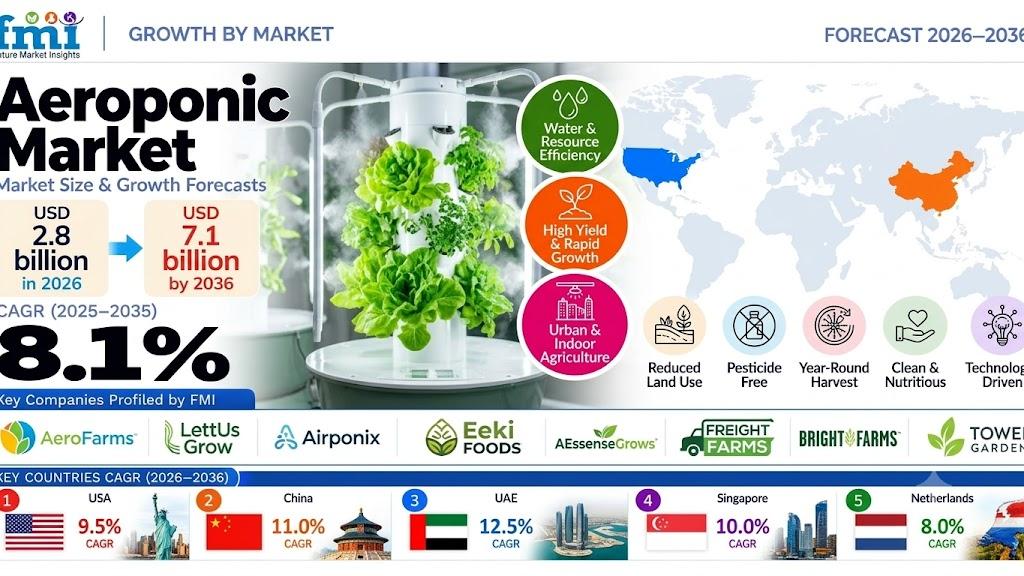
NEWARK, Del., October 21, 2026 — The global Aeroponic Market is gaining momentum as agricultural technology providers, commercial growers, and controlled-environment farming operators increasingly adopt innovative cultivation systems to improve resource efficiency and crop production. According to the latest market intelligence report published by Future Market Insights (FMI), the...
Silicon Carbide Power Semiconductor Market: What Is Driving Growth? The global Silicon Carbide Power Semiconductor Market is projected to grow from USD 2.3 billion in 2025 to USD 13.7 billion by 2034, representing a CAGR of 21.8%. According to Dimension Market Research, the market is being shaped by the rapid adoption of electric vehicles, renewable energy systems, high-efficiency power...

Advancements in molecular genetics and targeted biological therapies are transforming the treatment landscape for rare genetic tumor syndromes. Detailed analysis within the Neurofibromatoses Type Ii Therapecutics Market report demonstrates that NF2 (neurofibromatosis type 2, characterized by NF2-related schwannomatosis) results from loss-of-function mutations in the merlin tumor suppressor...
Niacinamide's rise has been remarkable, but the ingredient's path to mass adoption is not without obstacles. While the market grows at a healthy 7.78% CAGR, several structural constraints limit its full potential. Understanding these restraints is essential for suppliers, formulators, and brands navigating the Niacinamide Market. Formulation and Stability Challenges The primary technical...